
Are you considering installing, replacing, or repairing a ceiling cassette air conditioner in Hamamatsu?
In this article, we will thoroughly explain everything from the basic knowledge, including the differences between residential and commercial systems, to the installation cost estimates and the criteria for deciding between repair and replacement.
In conclusion, to avoid regrets when installing a ceiling cassette air conditioner, the most important factor is not choosing the cheapest option, but selecting a trusted local specialist with extensive experience and comprehensive warranty support.
By reading this article, you will learn the best solution for your specific situation and how to choose a reliable contractor in Hamamatsu, allowing you to request the work with confidence.

Based in Hamamatsu, we specialize in the design, installation, and maintenance of commercial air conditioning, HVAC, and pump systems.
With over 30 years of proven experience and technical expertise, we help create comfortable environments.
Trusted by many publicly listed companies, we take pride in our reliability and responsive service.
We also operate a branch in Malaysia, expanding our reach globally.
Learn more about our company
Contents
- 1. What Is a Ceiling Cassette Air Conditioner? Essential Knowledge to Know in Hamamatsu
- 2. Ceiling Cassette Air Conditioner Installation in Hamamatsu
- 3. Ceiling Cassette Air Conditioner Replacement Work in Hamamatsu
- 4. Ceiling Cassette Air Conditioner Repair in Hamamatsu
- 5. Key Points for Choosing a Reliable Ceiling Cassette Air Conditioner Contractor in Hamamatsu
- 6. Maintenance Tips to Extend the Lifespan of Your Ceiling Cassette Air Conditioner
- 7. Conclusion
1. What Is a Ceiling Cassette Air Conditioner? Essential Knowledge to Know in Hamamatsu
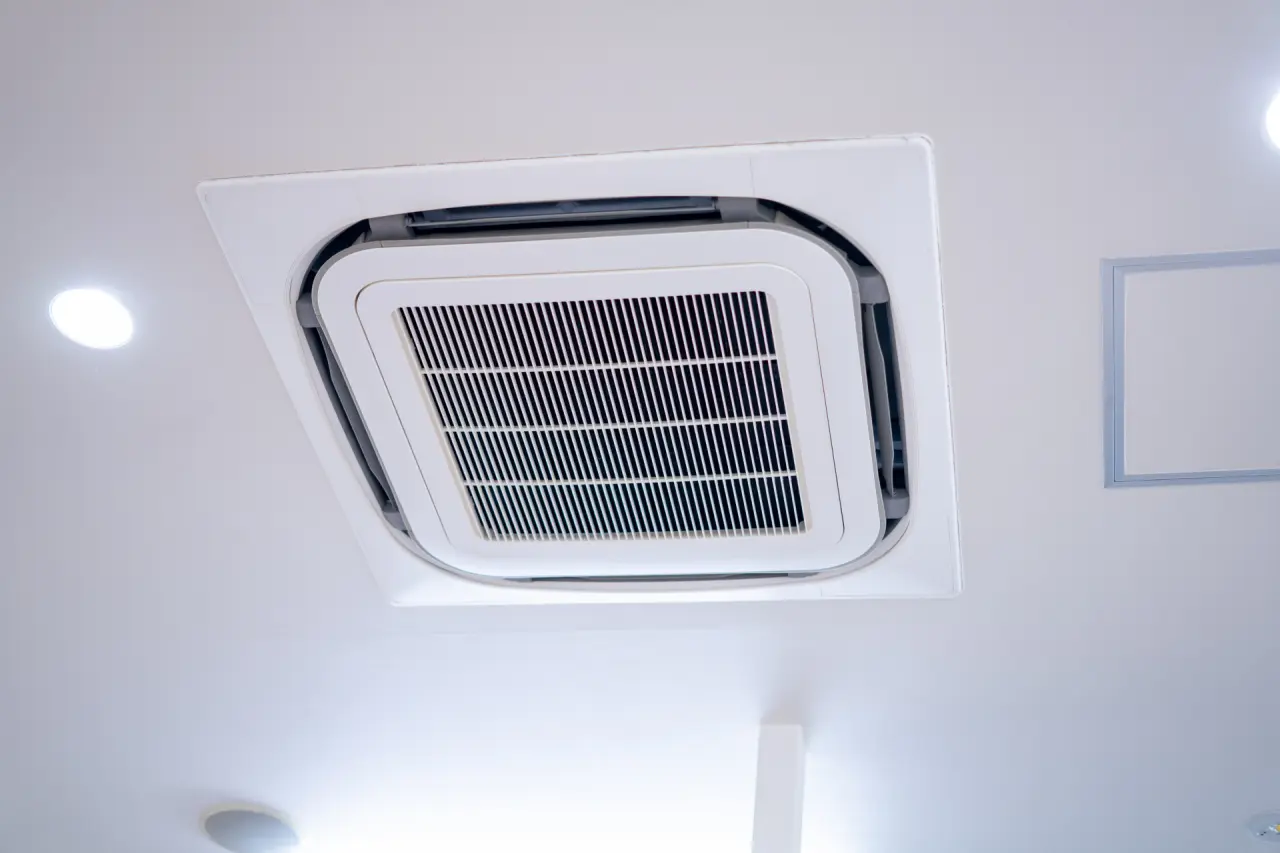
A ceiling cassette air conditioner is a type of air conditioning system in which the indoor unit is installed inside the ceiling, as the name suggests.
It is commonly referred to as a “Ceiling Cassette Air Conditioner” or a “Housing Air Conditioner.” Since the main unit is hidden from view, its greatest advantage is that it creates a clean and sophisticated space without disrupting the room’s interior design.
Hamamatsu City in Shizuoka Prefecture is known for having one of the highest amounts of sunshine in Japan. However, summers are hot and humid, while winters bring strong and cold seasonal winds known as the “Enshu Karakkaze.”
Therefore, choosing an air conditioner that can efficiently regulate the temperature throughout the entire room is extremely important for maintaining a comfortable indoor environment all year round.
Ceiling cassette air conditioners can easily be installed in the center of a room or other optimal locations, making them ideal for creating comfortable spaces with minimal temperature variation even under Hamamatsu’s challenging climate conditions.
1.1 Advantages and Disadvantages of Ceiling Cassette Air Conditioners
When considering a ceiling cassette air conditioner, it is important to understand both the advantages and disadvantages, as well as the differences compared to wall-mounted air conditioners.
The table below summarizes the main features of ceiling cassette air conditioners.
| Category | Advantages | Disadvantages |
|---|---|---|
| Design & Space | The unit is concealed inside the ceiling, allowing it to blend naturally with the interior while maximizing usable wall space. | Installation may not be possible if there is insufficient space above the ceiling. |
| Airflow Efficiency | Air outlets can be configured from one to four directions, allowing air to be distributed evenly throughout the room. | In rooms with high ceilings, warm air may accumulate near the ceiling, making a circulator fan necessary. |
| Cost & Installation | When installed during new construction or renovation projects, all piping can be concealed, creating a cleaner appearance. | The equipment itself is expensive, and ceiling opening and piping work are required, making installation and future replacement costs higher than wall-mounted units. |
| Maintenance | Many models have flat panels, making routine surface cleaning relatively easy. | Since the unit is installed overhead, removing filters and performing internal cleaning can be more difficult. |
In particular, for people building custom homes or carrying out full apartment renovations in Hamamatsu, the ability to create a sophisticated space while maintaining greater flexibility in room layouts is one of the biggest advantages unique to ceiling cassette air conditioners.
However, future maintenance and replacement costs should also be considered in your budget planning.
1.2 Differences Between Residential and Commercial Ceiling Cassette Air Conditioners
Ceiling cassette air conditioners are generally divided into two categories: residential (housing air conditioners) and commercial (package air conditioners).
Even within Hamamatsu, the ideal system varies depending on the building structure and intended use, whether it is a standard home, a mixed-use property, or a spacious open-plan living area.
It is important to understand these differences correctly and choose the product that best suits your needs.
| Comparison Point | Residential (Housing Air Conditioner) | Commercial (Package Air Conditioner) |
|---|---|---|
| Primary Installation Location | Living rooms, bedrooms, apartments, and general residential spaces | Restaurants, offices, factories, and commercial spaces within mixed-use properties |
| Power Supply | Single-phase 100V or Single-phase 200V | Three-phase 200V (industrial power) or Single-phase 200V |
| Cooling & Heating Capacity | Suitable for standard room sizes (approximately 6 to 20 tatami mats) | High-capacity systems designed for large spaces and environments with significant heat loads |
| Features & Design | Rich in comfort-oriented features such as air purification, humidification, and dehumidification | Designed for durability, energy efficiency, and long continuous operation |
Residential ceiling cassette air conditioners are available from major manufacturers such as Daikin, Panasonic, and Mitsubishi Electric, and many models offer customizable options, including wood-grain panels that complement interior designs.
For example, Daikin Housing Air Conditioners offer a wide range of products to meet various household needs.
On the other hand, if you operate a café, beauty salon, or other commercial business in Hamamatsu, or if your home has a very large LDK area, residential models may not provide sufficient capacity. In such cases, selecting a commercial ceiling cassette air conditioner that matches the size and heat load of the space can help maintain a comfortable indoor environment while reducing electricity costs.
If you are unsure which type to choose, we recommend requesting an on-site inspection from a local specialist who understands building structures and insulation performance and can provide professional advice.
2. Ceiling Cassette Air Conditioner Installation in Hamamatsu
Hamamatsu City enjoys long hours of sunshine throughout the year, and summers can be particularly hot, increasing the demand for ceiling cassette air conditioners (ceiling cassette units and housing air conditioners) that can efficiently cool and heat an entire space.
Many people consider installing them in newly built homes, during renovation projects, or for new installations in stores and offices. However, unlike wall-mounted air conditioners, ceiling cassette air conditioners require extensive construction work that directly involves the building structure.
Here, we will explain in detail the installation process, important considerations, and the estimated costs of installing a new ceiling cassette air conditioner in the Hamamatsu area.
2.1 Installation Process and Important Considerations
Installing a new ceiling cassette air conditioner requires thorough preparation and precise workmanship.
The general installation process is as follows.
- On-site Inspection and Consultation: A specialist visits the site to inspect the ceiling structure, piping routes, and the outdoor unit installation location.
- Quotation Preparation: Based on the inspection results, a detailed quotation including equipment and installation costs is prepared.
- Ceiling Opening and Piping Work: An opening is created in the ceiling for the indoor unit, and refrigerant pipes, drain pipes, and electrical cables are installed above the ceiling.
- Indoor and Outdoor Unit Installation: The units are securely fixed in their designated locations and connected to the piping system.
- Vacuuming and Test Operation: Air is removed from the piping system through a vacuum process, followed by operational testing to ensure everything is functioning properly.
The most important consideration during installation is the structural limitations of the building.
It is extremely important to confirm in advance that there is sufficient space above the ceiling (generally around 30 to 40 cm).
If there is insufficient space, additional renovation work, such as lowering the ceiling, may be required, potentially expanding the scope of the project significantly.
In densely populated residential areas within Hamamatsu, securing sufficient space and access routes for the outdoor unit can also be challenging. Therefore, conducting an on-site inspection rather than relying solely on building plans is essential.
2.2 Estimated Costs of Installing a Ceiling Cassette Air Conditioner
The installation cost of a ceiling cassette air conditioner varies significantly depending on the unit’s capacity (room size coverage) and the condition of the building.
Compared to wall-mounted systems, there are more installation steps involved, and interior construction work is often required, resulting in higher initial costs.
The following table shows the general cost estimates for installing a new residential ceiling cassette air conditioner (one-way or two-way airflow type) in the Hamamatsu area.
| Work / Cost Item | Estimated Cost | Details / Notes |
|---|---|---|
| Air Conditioner Unit Cost | ¥150,000 – ¥300,000 | Prices vary depending on room coverage, manufacturer (Daikin, Panasonic, Mitsubishi Electric, etc.), and installed features. |
| Basic Installation Cost | ¥40,000 – ¥80,000 | Includes indoor and outdoor unit installation, standard piping connections, vacuuming, and other basic work. |
| Ceiling Opening & Construction Work | ¥30,000 – ¥60,000 | Includes ceiling cutting and any necessary reinforcement or repair work. |
| Dedicated Power Supply Installation | ¥15,000 – ¥30,000 | Required when installing a new dedicated circuit (such as 200V) from the electrical panel. |
| Additional Piping & Decorative Cover Installation | ¥10,000 – ¥20,000 | Required when the outdoor unit is located farther away or when decorative covers are installed for a cleaner appearance. |
These figures are only estimates, and additional costs may arise depending on the building structure (wood-frame, steel-frame, or reinforced concrete) and the presence of obstacles above the ceiling.
For example, if the building structure does not allow natural drainage through gravity, a separate drain-up kit may be required to pump water out.
Choosing a contractor that performs a thorough on-site inspection and clearly explains any potential additional costs is key to avoiding future problems.
When searching for contractors in Hamamatsu, be sure to also confirm whether additional travel fees will be charged for companies located outside the area.
3. Ceiling Cassette Air Conditioner Replacement Work in Hamamatsu
If the cooling and heating performance of your ceiling cassette air conditioner (ceiling-mounted cassette air conditioner) in Hamamatsu has deteriorated or the unit has aged after years of use, replacing it with a new system rather than repairing it is often necessary.
Here, we will explain in detail the appropriate timing for replacing a ceiling cassette air conditioner in the Hamamatsu area, the specific replacement process, and the estimated costs involved.
3.1 Signs and Recommended Timing for Replacement
Since ceiling cassette air conditioners are more expensive than wall-mounted units in terms of both equipment and installation costs, replacing them at the right time is important.
Hamamatsu’s harsh climate, with hot and humid summers and cold seasonal winds known as the “Enshu Karakkaze” during winter, tends to place a heavy burden on air conditioning systems.
3.1.1 Service Life and Manufacturer Parts Availability Period
The lifespan of a ceiling cassette air conditioner varies depending on usage frequency and maintenance conditions, but generally ranges from 10 to 15 years.
Major manufacturers such as Daikin, Mitsubishi Electric, and Panasonic typically retain repair parts for approximately 9 to 10 years after production ends. Therefore, if an air conditioner that is more than 10 years old breaks down, there is a high possibility that replacement rather than repair will be necessary.
3.1.2 Specific Signs That Indicate Replacement Should Be Considered
If the following symptoms occur frequently, they are clear signs that the air conditioner is nearing the end of its lifespan.
We recommend consulting a specialist contractor in Hamamatsu about replacement options before the unit completely fails.
- Abnormal noises (rattling, squealing, etc.) or vibrations are coming from the indoor unit.
- The room does not reach a comfortable temperature even after lowering (or raising) the thermostat setting.
- Water is leaking from the indoor unit, or unpleasant mold odors cannot be eliminated.
- The circuit breaker frequently trips, or error codes are displayed.
- Electricity costs have become unusually high compared to the latest energy-efficient models.
3.2 Replacement Process and Costs
There are many factors that must be confirmed in advance during ceiling cassette air conditioner replacement work, such as whether the existing ceiling opening can be reused and whether the current piping can be utilized.
Therefore, an accurate on-site inspection by a contractor with specialized knowledge and technical expertise is essential.
3.2.1 Basic Replacement Process
When you request a reliable air conditioning contractor in Hamamatsu to perform the replacement, the work generally proceeds through the following steps.
- On-site Inspection and Quotation: The contractor visits the site to inspect the dimensions of the existing air conditioner, the condition of the piping and wiring, and the installation access route. If the ceiling opening dimensions need to be changed, they will also determine whether ceiling repairs or panel adjustments are necessary.
- Model Selection and Contract: Based on the inspection results, the most suitable model from manufacturers such as Daikin or Mitsubishi Electric will be proposed, and the contract will proceed once you approve the quotation.
- Protective Covering and Removal of Existing Equipment: On the day of installation, furniture and flooring are carefully protected, and the old indoor unit, outdoor unit, and unnecessary piping are safely removed.
- Installation of the New Air Conditioner and Piping Connections: The new indoor unit is suspended from the ceiling, the outdoor unit is installed, and the refrigerant piping, drain piping, and electrical wiring are connected.
- Vacuuming and Test Operation: After performing a vacuum process to remove air and moisture from the piping, a test operation is conducted to confirm proper cooling and heating performance and ensure there are no water leaks before the project is completed.
3.2.2 Estimated Replacement Costs
Replacing a ceiling cassette air conditioner involves several expenses, including the cost of the new unit, removal and disposal of existing equipment, and installation work.
The following table summarizes the typical cost ranges for replacing residential (housing air conditioners) and small commercial ceiling cassette air conditioners.
| Cost Breakdown | Residential (1-Way / 2-Way Airflow) Price Range | Commercial (4-Way Cassette, etc.) Price Range |
|---|---|---|
| Air Conditioner Unit Price | ¥150,000 – ¥250,000 | ¥200,000 – ¥500,000 |
| Standard Replacement Installation Cost | ¥60,000 – ¥100,000 | ¥80,000 – ¥150,000 |
| Existing Equipment Removal & Disposal | ¥10,000 – ¥20,000 | ¥15,000 – ¥30,000 |
| Additional Construction Costs (Ceiling Opening Adjustments, etc.) | ¥10,000 – ¥30,000 | ¥20,000 – ¥50,000 |
When disposing of old commercial ceiling cassette air conditioners, the law requires refrigerant gases to be properly recovered and destroyed. Failure to comply may result in penalties.
Therefore, when selecting a replacement contractor in Hamamatsu, it is extremely important to hire a reliable company that is registered as a Class 1 Fluorocarbon Recovery Operator in compliance with the Fluorocarbons Emission Control Act.
4. Ceiling Cassette Air Conditioner Repair in Hamamatsu
Ceiling cassette air conditioners (ceiling cassette units) are widely used in homes, stores, and offices throughout Hamamatsu, regardless of whether they are residential or commercial systems.
However, after long-term use, issues such as “poor cooling performance” or “water dripping from the unit” may occur.
Here, we will explain in detail the common problems, troubleshooting methods, and estimated repair costs you should know when considering ceiling cassette air conditioner repairs in Hamamatsu.
4.1 Common Problems and Troubleshooting Methods
There are several common patterns of problems associated with ceiling cassette air conditioners.
Depending on the symptoms, some issues can be resolved by yourself before calling a professional repair company.
4.1.1 The Air Conditioner Is Not Cooling or Heating Properly
If the cooling or heating performance is poor, first suspect a clogged air filter.
Regular filter cleaning can often improve reduced airflow and poor performance.
If the issue persists, refrigerant gas leakage or a malfunctioning compressor in the outdoor unit may be the cause, and an inspection by a professional contractor will be necessary.
4.1.2 Water Is Leaking from the Unit
When water drips from a ceiling cassette air conditioner, the most common causes are a dirty drain pan (the tray that collects condensation), a malfunctioning drain pump, or a clogged drain hose.
If left unattended, this can lead to ceiling stains and mold growth, so it is important to request cleaning or repairs from a professional contractor as soon as possible.
4.1.3 Error Codes Are Displayed or Indicator Lights Are Flashing
If an error code appears on the remote controller or the indicator lights on the unit flash and operation stops, it is a sign that there may be a problem with the internal sensors or control board.
Check the meaning of the error code in the instruction manual provided by manufacturers such as Daikin, Panasonic, and Mitsubishi Electric, or on official websites such as Daikin’s Error Code Search Page. If resetting the unit does not resolve the issue, request a repair service.
4.2 Which Is Better: Repair or Replacement? Key Decision Points
When an air conditioner breaks down, deciding whether to repair it or replace it with a new unit can be difficult.
Use the table below as a reference to make the right decision based on your situation.
| Criteria | When Repair Is Recommended | When Replacement Is Recommended |
|---|---|---|
| Years of Use | Less than 10 years since purchase | More than 10 years since purchase |
| Repair Cost | When the repair can be completed for several tens of thousands of yen | When expensive parts replacement is required and the cost exceeds half the price of a new unit |
| Parts Availability | The manufacturer still has replacement parts in stock | The manufacturer’s parts retention period (typically 9 to 10 years) has ended |
| Energy Efficiency | You are satisfied with the current energy performance and electricity costs | Your electricity bills are high and you want to switch to the latest energy-efficient model |
In particular, the manufacturer’s parts retention period is an important guideline.
For air conditioners that have been discontinued for more than 10 years, repair may no longer be possible because replacement parts are unavailable, making replacement the wiser option.
4.3 Ceiling Cassette Air Conditioner Repair Costs
The cost of repairing a ceiling cassette air conditioner in Hamamatsu varies significantly depending on the failed component, replacement parts required, and the complexity of the work.
The following table shows general repair cost estimates.
| Repair Type / Problem Area | Estimated Cost | Notes |
|---|---|---|
| Water Leak Repair (Clearing Drain Blockages, etc.) | ¥10,000 – ¥25,000 | Additional charges may apply if extensive cleaning, such as high-pressure cleaning, is required. |
| Refrigerant Gas Recharge & Leak Repair | ¥15,000 – ¥40,000 | Costs vary depending on the type of refrigerant and whether welding repairs are necessary at the leak location. |
| Control Board Replacement & Sensor Repair | ¥20,000 – ¥50,000 | Costs vary significantly depending on the manufacturer and parts pricing. |
| Outdoor Unit Compressor Replacement | ¥50,000 – ¥100,000+ | Since this repair is very expensive, replacing the entire unit may be recommended depending on its age. |
In actual repair cases, additional fees such as travel charges and elevated work fees may be added to the costs listed above.
Local contractors in Hamamatsu generally tend to charge lower travel fees compared to companies located farther away.
To accurately understand the total cost, always request an on-site inspection and quotation before proceeding with repairs.
5. Key Points for Choosing a Reliable Ceiling Cassette Air Conditioner Contractor in Hamamatsu
Ceiling cassette air conditioners are more structurally complex than standard wall-mounted air conditioners, requiring advanced expertise and technical skills for installation and repair.
Therefore, choosing the wrong contractor increases the risk of poor workmanship, such as water leaks and inadequate cooling or heating performance.
There are many HVAC contractors in Hamamatsu, but here we will explain the key points for identifying a trustworthy and reliable company you can confidently hire.
5.1 Checklist When Requesting a Quote
The first step in choosing a contractor is obtaining quotations from multiple companies.
Not only will this help you understand the market rates in the Hamamatsu area, but it will also allow you to compare each company’s level of customer service.
When reviewing a quotation, do not focus solely on the total price; make sure the breakdown is clearly detailed.
Be cautious of contractors who simply list “installation work included” without providing a detailed cost breakdown.
| Checklist Item | Specific Points to Confirm |
|---|---|
| Clarity of Cost Breakdown | Check whether the air conditioner unit cost, piping work, existing equipment removal and disposal fees, travel charges, and other expenses are itemized separately. |
| Potential Additional Costs | Confirm whether the conditions and costs for possible additional work, such as ceiling expansion or electrical work, are explained in advance. |
| Response Speed | Check whether the contractor responds quickly and communicates professionally from the initial inquiry through the on-site inspection and quotation submission. |
5.2 The Importance of Experience and Warranty Coverage
Ceiling cassette air conditioner installation requires precise work that complies with the specifications of manufacturers such as Daikin, Mitsubishi Electric, and Panasonic.
Check the company’s website to see whether they have extensive experience installing ceiling cassette air conditioners in stores, offices, and residential properties throughout the Hamamatsu area.
Contractors with extensive experience are more likely to provide flexible solutions that accommodate different building structures.
In addition, electrical work for air conditioners legally requires certification as a Second-Class Electrician or higher.
Work performed by unlicensed individuals is not only illegal but may also lead to serious accidents, including fires.
Refer to information provided by organizations such as the Japan Electrical Technician Examination Center, and choose a contractor that employs qualified technicians who will perform the work properly.
5.2.1 Comprehensive After-Sales Support and Warranty Periods
Installing an air conditioner is not the end of the process.
In case gas leaks or operational problems occur after installation, it is extremely important to confirm that comprehensive installation warranties and extended equipment warranties are provided.
Reliable contractors typically offer their own workmanship warranties and respond quickly at no additional cost if problems occur.
5.2.2 Why Local Hamamatsu Contractors Are Recommended
When searching for a contractor in Hamamatsu, locally based HVAC companies are highly recommended.
If an air conditioner breaks down during the peak of summer or winter, immediate service is essential.
Contractors with offices located within Hamamatsu have the major advantage of shorter travel times, allowing them to respond quickly to emergency situations.
In addition, because they highly value their local reputation, they tend to provide attentive and responsible customer service.
6. Maintenance Tips to Extend the Lifespan of Your Ceiling Cassette Air Conditioner
Ceiling cassette air conditioners have a more complex structure than standard wall-mounted air conditioners, so proper daily maintenance has a significant impact on their lifespan.
Regular maintenance can help reduce electricity costs, prevent mold and unpleasant odors, and maintain a comfortable indoor environment for many years.
Here, we will explain effective maintenance methods that take Hamamatsu’s climate into account, as well as tips for using your air conditioner without putting unnecessary strain on the system.
6.1 Daily Maintenance You Can Do Yourself
Daily care that homeowners can perform themselves is essential for extending the lifespan of a ceiling cassette air conditioner.
In particular, filter cleaning is an important task that directly affects cooling and heating performance as well as power consumption.
6.1.1 Regular Filter Cleaning
When dust accumulates on the filters, airflow decreases, making it take longer to reach the desired temperature and placing additional strain on the air conditioner.
Remove and clean the filters every two weeks, or at least once a month, by vacuuming away dust or washing them with water.
If you wash the filters with water, it is important to let them dry completely in the shade before reinstalling them to prevent mold growth.
6.1.2 Wiping the Air Outlet and Panel
During cooling operation, condensation easily forms, making mold more likely to grow around the air outlets and louvers (airflow direction fins).
Use a soft cloth dampened with warm water and thoroughly wrung out to gently wipe dirt from the panel surface and air outlets.
If the dirt is severe, use a diluted neutral detergent and finish by wiping with clean water to ensure no detergent residue remains.
6.2 The Importance of Regular Professional Air Conditioner Cleaning
There are limits to what can be cleaned by yourself, and dirt or mold that accumulates inside the aluminum fins (heat exchanger), drain pan (condensation tray), and blower fan cannot be removed through regular household cleaning.
If internal contamination is left untreated, it can lead to water leaks, unpleasant odors, and, in the worst cases, serious equipment failures.
Therefore, we strongly recommend scheduling professional deep cleaning (air conditioner cleaning) every one to two years.
Using professional techniques, specialized detergents, and high-pressure cleaning equipment, technicians can thoroughly remove stubborn internal dirt and restore both the original performance of the air conditioner and clean indoor air quality.
6.3 Maintenance Schedule and Checklist
The following table summarizes the recommended maintenance frequency and inspection items to keep your ceiling cassette air conditioner in good condition.
Since Hamamatsu experiences high humidity and frequent air conditioner use during summer, maintenance before the peak season is especially important.
| Maintenance Item | Recommended Frequency | Tasks / Checkpoints |
|---|---|---|
| Filter Cleaning | Every 2 Weeks to Once a Month | Vacuum dust or wash with water (allow to dry completely) |
| Panel & Louver Cleaning | Once a Month | Wipe with a tightly wrung cloth and remove dust and black stains (mold) |
| Test Operation (Cooling & Heating) | Spring and Autumn Before Each Season | Check for unusual noises, unpleasant odors, and proper cooling and heating performance |
| Professional Deep Cleaning | Once Every 1 to 2 Years | High-pressure cleaning of the internal heat exchanger, drain pan, and blower fan |
6.4 Tips for Using Your Air Conditioner Without Overloading It
In addition to physical cleaning, daily usage habits also greatly affect the lifespan of components such as compressors and motors.
By following the points below, you can reduce the risk of breakdowns.
6.4.1 Choosing Appropriate Temperature Settings and Operating Modes
Extreme temperature settings place significant strain on the equipment. As recommended by the Agency for Natural Resources and Energy’s Energy Conservation Portal, maintaining reasonable room temperature settings not only saves energy but also helps extend the lifespan of the equipment.
In addition, if you are leaving home for only a short period of time, it may be more efficient to leave the air conditioner running rather than repeatedly turning it on and off, which can place a heavy load on the system during startup.
6.4.2 Utilizing Internal Cleaning Functions and Fan Mode
After cooling or dehumidifying operation, moisture from condensation remains inside the air conditioner, and if left untreated, mold can spread rapidly.
The key to extending the lifespan of your air conditioner is to run the fan mode for several hours after operation or use the built-in internal cleaning (drying) function to thoroughly dry the inside of the unit.
A few simple daily habits can make a significant difference in keeping your ceiling cassette air conditioner clean and operating efficiently for many years.
7. Conclusion
Installing, replacing, and repairing ceiling cassette air conditioners in Hamamatsu requires specialized knowledge and technical expertise.
While these systems offer the advantage of creating a clean and sophisticated appearance, installation costs tend to be higher than those of wall-mounted air conditioners. Therefore, the key to avoiding costly mistakes is to choose a locally based contractor with extensive experience installing products from major domestic manufacturers such as Daikin and Panasonic, along with transparent quotations and comprehensive warranty coverage.
In addition, if your air conditioner is more than 10 years old and begins showing signs of trouble such as unusual noises or water leaks, replacing it with the latest energy-efficient model is often a better option than repairing it.
Perform regular cleaning and maintenance to keep your indoor environment comfortable and extend the lifespan of your air conditioner.