
For those operating stores or offices in Hamamatsu City, are you struggling each month as you look at your commercial air conditioner electricity bills and wonder, “Isn’t there a way to make this cheaper?”
In Hamamatsu, where summers are extremely hot and winters can be quite cold, air conditioning is essential. However, the key to significantly reducing those costs lies in “proper maintenance.”
Simply neglecting regular upkeep can dramatically reduce your air conditioner’s efficiency, causing you to continue paying unnecessary electricity costs.
In this article, we comprehensively explain practical methods to reduce electricity costs for commercial air conditioners—from filter cleaning you can do yourself, to professional disassembly cleaning, effective temperature setting strategies, and even energy-saving subsidy programs available in Hamamatsu City.
By reading through to the end, you will gain cost-saving knowledge that can be applied immediately starting tomorrow, helping improve air conditioning efficiency and stabilize your business operations.

Based in Hamamatsu, we specialize in the design, installation, and maintenance of commercial air conditioning, HVAC, and pump systems.
With over 30 years of proven experience and technical expertise, we help create comfortable environments.
Trusted by many publicly listed companies, we take pride in our reliability and responsive service.
We also operate a branch in Malaysia, expanding our reach globally.
Learn more about our company
Contents
1. The Importance of Maintenance That Determines Energy Efficiency of Commercial Air Conditioners in Hamamatsu
Commercial air conditioners operate daily in offices, stores, and factories throughout Hamamatsu City.
In this region, where summers are extremely hot and winters can be quite cold, they can be considered a lifeline for maintaining a comfortable business environment.
However, at the same time, monthly electricity costs tend to become a significant burden on management.
To reduce these costs and achieve high energy efficiency, the most important yet often overlooked factor is “regular maintenance”.
Maintenance is not just simple cleaning work.
It is part of a management strategy to reduce unnecessary costs, extend the lifespan of equipment, and fulfill legal obligations.
In this section, we will take a deeper look at why maintenance is directly linked to energy efficiency and the specific reasons behind it.
1.1 Why Does Lack of Maintenance Lead to Higher Electricity Costs?
Why do electricity costs increase when maintenance of commercial air conditioners is neglected?
The primary reason is the “decline in heat exchange efficiency.” Air conditioners regulate temperature by transferring heat between indoors and outdoors, and the components that play a central role in this process are the “filters” and “heat exchangers (fins).”
When dust and dirt clog the filters, airflow is obstructed, preventing the air conditioner from drawing in sufficient indoor air.
This is like a person trying to sprint while wearing a mask, and to reach the set temperature, excessive load is placed on the compressor, resulting in a significant increase in power consumption.
Some studies show that simply cleaning filters regularly can reduce power consumption by approximately 5% to 15%.
The table below compares how the presence or absence of maintenance affects the operation of commercial air conditioners.
| Item | With Regular Maintenance | Without Maintenance |
|---|---|---|
| Heat exchange efficiency | Maintained at a high level | Significantly reduced |
| Power consumption | Maintains original performance and avoids unnecessary energy use | May increase by more than 20% in some cases |
| Annual electricity cost (estimate) | Kept at an appropriate level | May increase by tens to hundreds of thousands of yen |
| Air conditioner lifespan | Expected to reach its designed service life | Component deterioration accelerates, shortening lifespan |
In this way, neglecting maintenance is essentially the same as continuously wasting money through electricity costs without realizing it.
To run a business efficiently in Hamamatsu, addressing this invisible cost is essential.
1.2 Neglect Is Dangerous! Risk of Failure and Impact on Business
The problems caused by lack of maintenance are not limited to rising electricity costs.
A more serious issue is the “risk of unexpected breakdowns.”
The accumulation of dust and dirt negatively affects not only the heat exchanger but also various components such as fan motors and drain pans (which collect condensation water).
For example, if dirt accumulates in the drain pan and drainage becomes ineffective, water leakage may occur.
If water leaks from the ceiling, it can damage products and office equipment, and repairing the interior may also incur significant costs.
In addition, if the outdoor unit’s heat exchanger becomes dirty, heat cannot be released properly, causing the compressor to overheat abnormally. In the worst case, the compressor—the heart of the air conditioner—may seize, resulting in repair costs of hundreds of thousands of yen or even requiring full equipment replacement.
In Hamamatsu, where there are many restaurants and commercial facilities, the impact of air conditioner failure during midsummer is immeasurable.
Customers visit expecting a comfortable environment.
If the air conditioning is not functioning, customer traffic will decrease, directly leading to lost sales opportunities.
Employee productivity will also drop significantly, and the risk of heatstroke will increase.
Sudden breakdowns are not just repair costs—they represent a major business risk that can cause secondary damages such as decreased revenue and loss of customer trust.
1.3 Legal Regulations and Obligations for Commercial Air Conditioners in Hamamatsu
Even if you think, “Our air conditioner is still working, so it’s fine,” caution is necessary.
In fact, owners of commercial air conditioners are legally required to conduct inspections.
This is mandated by the “Fluorocarbon Emission Control Act” (officially: Act on Rational Use and Proper Management of Fluorocarbons).
This law aims to reduce emissions of fluorocarbons, which contribute to ozone layer depletion and global warming, and applies to businesses throughout Japan, including those in Hamamatsu City.
Specifically, managers (such as owners) of commercial air conditioners (Type 1 specified products) are required to fulfill the following obligations:
- Simple inspections: All commercial air conditioners must be inspected at least once every three months, even without specialized knowledge, checking for abnormal noise, vibration, or visible damage.
- Periodic inspections by professionals: For units with a rated compressor output of 7.5 kW or higher, regular inspections by qualified professionals (once every 1 to 3 years) are mandatory.
- Record keeping: All inspection and repair records must be documented and retained until the equipment is disposed of.
- Response to refrigerant leaks: If a leak is detected, it must be repaired promptly. If the annual leakage exceeds a certain threshold, reporting to the government is required.
If these obligations are neglected and violations are discovered through inspections by prefectural authorities, guidance, recommendations, or orders may be issued, and failure to comply may result in fines (up to 500,000 yen).
For more details, please refer to the Ministry of the Environment website.
(Fluorocarbon Emission Control Act Portal – Ministry of the Environment)
Therefore, maintenance of commercial air conditioners is not only important for energy savings and preventing breakdowns but is also an essential initiative from the perspectives of legal compliance and environmental responsibility.
2. Simple Maintenance Tips You Can Do Daily
While professional deep cleaning by specialists is essential, simply practicing easy daily maintenance can significantly improve the energy efficiency of commercial air conditioners.
It not only helps reduce electricity costs but also extends the lifespan of the equipment and lowers the risk of unexpected breakdowns.
Here, we introduce two important maintenance techniques that anyone can easily start today.
2.1 Improve Efficiency of Commercial Air Conditioners in Hamamatsu with Filter Cleaning
Among energy-saving measures for commercial air conditioners, the most basic and effective one is filter cleaning.
When dust and dirt clog the filter, airflow is blocked, and the air conditioner must use more power than usual to draw in air.
As a result, cooling and heating efficiency drops significantly, and power consumption increases substantially.
In Hamamatsu, which is characterized by a hot and humid climate, dust tends to absorb moisture and stick to filters easily, making frequent cleaning essential.
According to data from the Agency for Natural Resources and Energy, simply cleaning air conditioner filters once or twice a month can reduce power consumption by about 4% during cooling and about 6% during heating.
The cleaning frequency varies depending on the installation environment. Use the table below as a guideline and perform regular cleaning.
| Installation Environment | Recommended Cleaning Frequency | Examples |
|---|---|---|
| Low-traffic environment | Once a month | Small offices, executive rooms, etc. |
| General environment | Once every two weeks | Offices, clinics, retail stores, etc. |
| Dust-prone environment | Once a week |
2.1.1 Basic Steps for Filter Cleaning
- Ensure safety: Always turn off the breaker of the commercial air conditioner and confirm that the power is completely shut off.
- Remove the filter: Follow the instruction manual of the air conditioner, open the front panel, and carefully remove the filter.
- Remove dust: Use a vacuum cleaner to remove large dust particles on the surface of the filter. It is recommended to use a brush attachment to avoid damaging the filter.
- Wash with water: If the dirt is heavy, wash it with water. If oil stains are present, gently scrub with a soft brush or sponge using diluted neutral detergent.
- Drying: After washing, lightly wipe off moisture with a towel and let it dry completely in a well-ventilated area away from direct sunlight. Installing it while still damp may cause mold and unpleasant odors, so thorough drying is essential.
- Reinstall: Once the filter is completely dry, securely reinstall it in its original position and close the front panel.
2.2 Improving the Environment Around the Outdoor Unit Also Contributes to Energy Savings
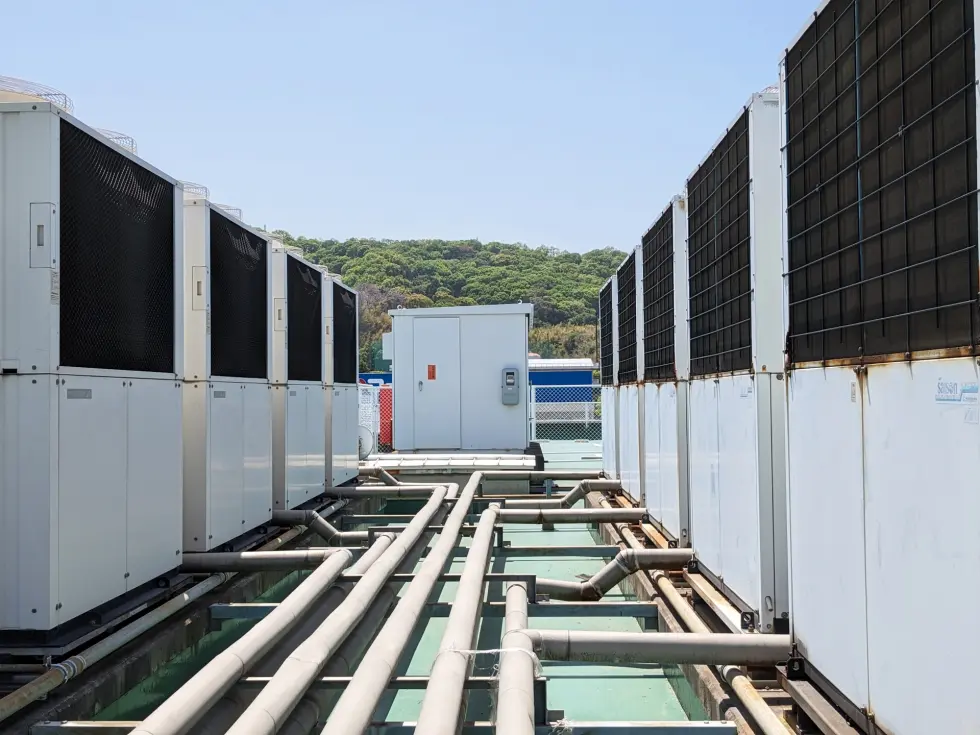
Just like the indoor unit, the environment around the outdoor unit installed outside also has a significant impact on energy efficiency.
The outdoor unit plays a crucial role in “heat exchange”—releasing indoor heat outside during cooling and absorbing outdoor heat during heating.
However, if objects are placed around the air intake or exhaust of the outdoor unit, or if weeds grow densely, airflow is obstructed and heat exchange efficiency decreases significantly.
As a result, extra load is placed on the air conditioner, leading to unnecessary power consumption.
In Hamamatsu, especially in coastal areas where strong winds are common, objects may unintentionally be blown around and block the outdoor unit.
Regularly checking the surroundings of the outdoor unit and maintaining good airflow is the first step toward efficient energy-saving operation.
2.2.1 Checkpoints Around the Outdoor Unit
- Secure space around air intake and exhaust: Ensure sufficient space around the outdoor unit so as not to obstruct airflow. Avoid placing items such as potted plants, bicycles, or trash bins near the front or back of the unit. Ideally, keep at least 20 cm in front and 5 cm on the sides and rear.
- Remove weeds and fallen leaves: Weeds tend to grow quickly in summer and may block the intake. Regularly remove weeds and clear fallen leaves.
- Protection from direct sunlight: Strong summer sunlight can raise the temperature of the outdoor unit, reducing heat exchange efficiency. Installing a bamboo screen (yoshizu) slightly away from the unit or using a commercially available sunshade panel for outdoor units can provide up to about 10% energy savings. However, be careful not to block the exhaust outlet when installing shade.
Avoid attempting to clean the outdoor unit’s fins (heat exchanger) yourself using high-pressure washers.
The fins are very delicate and can be deformed or damaged, potentially leading to serious malfunctions.
For internal cleaning of the fins, always consult a professional contractor with specialized knowledge and skills.
3. Regular Inspections by Professionals and Expert Maintenance
While daily filter cleaning and maintaining the environment around the outdoor unit are important, regular maintenance by professional contractors is essential to truly maximize and sustain the energy efficiency of commercial air conditioners over the long term.
Dirt accumulated inside and the condition of refrigerant gas, which cannot be seen with the naked eye, cannot be properly diagnosed or handled without professional expertise.
Here, we will explain in detail the types of maintenance that only professionals can perform and key points for choosing a reliable contractor in Hamamatsu.
3.1 Thorough Cleaning of Commercial Air Conditioners by Professionals
Because commercial air conditioners operate for long hours, not only dust but also oil residue, mold, and bacteria tend to accumulate inside.
These not only cause unpleasant odors and allergies but also significantly reduce heat exchange efficiency and increase power consumption.
Professional contractors disassemble the air conditioner and use specialized equipment and chemicals to thoroughly clean every part of the interior.
Professional disassembly cleaning is the most effective method to restore key components such as the heat exchanger and blower fan—essentially the heart of the air conditioner—to near-new condition and recover its original energy-saving performance.
| Item | Daily Cleaning | Professional Deep Cleaning |
|---|---|---|
| Cleaning scope | Filter, exterior panel, area around outdoor unit | All internal components including filter, exterior panel, heat exchanger (fins), drain pan, blower fan (sirocco fan), etc. |
| Equipment used | Vacuum cleaner, cloth, brush, etc. | High-pressure washers, specialized detergents, protective sheets, drain pumps, and full professional equipment |
| Expected effects | Prevents airflow reduction due to clogging | Significant reduction in power consumption (examples of 15–30% reduction), complete removal of odors and mold, full recovery of airflow and cooling performance, reduced risk of failure |
| Recommended frequency | Once every 2 weeks to 1 month | Once every 1 to 3 years (depending on environment and usage) |
Especially in environments with high levels of oil or dust, such as restaurants and factories, dirt accumulates quickly, and annual deep cleaning is recommended.
Even in offices and retail spaces in Hamamatsu, regular professional cleaning can be considered an investment directly linked to reducing electricity costs.
3.2 Refrigerant Gas Inspection and Refilling: The Key to Energy Efficiency
Refrigerant gas, often referred to as the “blood” of an air conditioner, plays a crucial role in transporting heat.
If this refrigerant gradually leaks due to pipe deterioration or loose connections, the air conditioner must overwork the compressor to reach the set temperature.
As a result, cooling efficiency drops significantly, and power consumption increases substantially.
Furthermore, under the “Fluorocarbon Emission Control Act” enforced in 2015, managers (owners) of commercial air conditioners and refrigeration equipment are required to conduct regular simple inspections and periodic inspections by professionals.
If a refrigerant leak is detected, repair and gas refilling are required. For more details, please refer to the Ministry of the Environment website.
Measuring refrigerant pressure, identifying leak points, and refilling gas must be performed by certified professionals such as “Class 1 Refrigerant Handling Technicians.”
From both energy efficiency and legal compliance perspectives, regular refrigerant inspections are an essential maintenance task.
3.3 How to Choose a Reliable Maintenance Contractor in Hamamatsu
There are many commercial air conditioner maintenance contractors in Hamamatsu City, but their technical capabilities and service quality vary.
To entrust your valuable equipment and achieve reliable energy-saving results, careful selection of a contractor is crucial.
Use the following points as a reference and compare multiple contractors.
Do not choose based solely on price; instead, evaluate technical skills, track record, and quality of service comprehensively, and obtain multiple quotes to avoid failure.
| Checklist Item | What to Confirm | Why It Matters |
|---|---|---|
| Licenses and certifications | Is the contractor registered as a “Class 1 Fluorocarbon Filling/Recovery Operator”? Do technicians hold relevant certifications (e.g., refrigerant handling qualifications)? | Proof that proper work (such as refrigerant recovery and filling) can be carried out legally. Work by unlicensed contractors is illegal. |
| Track record and expertise | Do they have extensive experience in Hamamatsu or nearby areas? Do they have experience in your industry (retail, factory, office buildings, etc.)? | They are more likely to understand local climate and building characteristics and handle industry-specific issues such as oil or dust. |
| Quotation transparency | Are the details of the work clearly listed? Are costs itemized instead of lump-sum? Are conditions for additional charges clearly explained? | To avoid unfair overcharging and ensure you understand and agree to the scope and cost before signing a contract. |
| On-site inspection and explanation | Do they conduct an on-site inspection before contracting and properly diagnose the air conditioner’s condition? Do they explain the situation and required work clearly? | Indicates accurate assessment and a customer-focused approach. |
| Liability insurance | Are they covered by liability insurance in case of accidents during work (equipment damage, water leaks, etc.)? | Provides peace of mind in case of damage to expensive equipment or property. |
Phone response and the personality of the representative during inquiries are also important evaluation factors.
Finding a trustworthy contractor who can serve as a long-term partner will lead to comfortable and energy-efficient business operations in Hamamatsu.
4. Energy-Saving Operation Tips to Practice Along with Maintenance
Regular maintenance is essential to maximize the energy efficiency of commercial air conditioners.
However, by reviewing daily “operation methods” at the same time, further reductions in electricity costs and environmental impact can be expected.
Here, we explain effective energy-saving operation tips that can be implemented immediately in offices, stores, and factories in Hamamatsu from three perspectives.
4.1 Smart Energy Saving by Optimizing Temperature Settings
The factor that has the greatest impact on the power consumption of commercial air conditioners is the “temperature setting.”
The Ministry of the Environment recommends setting indoor temperatures to 28°C during summer cooling and 20°C during winter heating as a guideline for achieving energy savings without compromising comfort.
In general, raising the cooling set temperature by 1°C can reduce power consumption by about 13%, and lowering the heating set temperature by 1°C can reduce it by about 10%.
However, it is not realistic to force temperature changes at the expense of employee or customer comfort.
This is where controlling perceived temperature becomes important.
By using air circulators or fans to circulate indoor air, temperature unevenness can be reduced, allowing for comfortable conditions even with moderate temperature settings.
Additionally, in summer, blocking direct sunlight with blinds or heat-shield curtains, and in winter, allowing sunlight in, can significantly reduce the load on air conditioning.
These small daily improvements can lead directly to significant cost reductions throughout the year.
4.2 Considering Replacement with the Latest Energy-Efficient Commercial Air Conditioners
If your commercial air conditioner is more than 10 years old, it is highly worthwhile to consider replacing it with a modern energy-efficient model.
Technological advancements have been remarkable, and recent commercial air conditioners offer dramatically improved energy efficiency.
For example, compared to models from 15 years ago, newer models can reduce power consumption by more than 50% in many cases.
This not only lowers electricity costs but also contributes to environmental protection by reducing CO2 emissions.
Signs such as “reduced cooling performance,” “loud operation noise,” or “increasing repair costs” are key indicators that it is time to consider replacement.
Modern models offer not only energy efficiency but also added value such as human detection sensors, AI-based automatic control, quiet operation, and improved comfort through airflow control.
Please refer to the table below for general differences between older and newer models.
| Comparison Item | Older Models (10–15 years ago) | Latest Energy-Efficient Models |
|---|---|---|
| Annual power consumption | High | Significantly lower (up to over 50% reduction) |
| Annual electricity cost | High | Can be significantly reduced |
| Comfort | Prone to uneven temperature, noisy operation | Comfortable airflow control, quiet operation |
| Additional features | Basic cooling and heating functions only | Human sensors, AI automatic control, automatic filter cleaning, etc. |
| Failure risk | High due to aging | Low |
Although initial investment is required, the reduction in monthly electricity costs often allows the investment to be recovered within a few years, making it a very smart long-term decision.
Consider consulting a reliable local contractor in Hamamatsu to receive recommendations for the most suitable model based on your usage conditions and building characteristics.
4.3 Energy-Saving Subsidy Programs Available in Hamamatsu
When considering replacing your system with the latest energy-efficient commercial air conditioners, subsidy and grant programs offered by the government and local authorities can provide significant support.
These programs help reduce the burden of initial costs, so it is worth considering their use.
In Hamamatsu City, subsidy programs may be available to support the introduction of energy-saving equipment for small and medium-sized businesses.
One example is the “Hamamatsu City Energy-Efficient Equipment Introduction Support Subsidy for SMEs.”
By utilizing such programs, it is possible to receive partial financial support for equipment investment costs.
Since eligible equipment, conditions, and application periods vary by year, it is important to check the latest information on official websites.
For the latest information and detailed application requirements, please refer to the official Hamamatsu City website and the Sustainable Open Innovation Initiative (SII) website, which oversees national programs such as the “Subsidy for Advanced Energy-Saving Investment Promotion.”
As the application process can be complex, consulting a professional contractor with extensive experience in subsidy applications is also a good option.
By making smart use of subsidy programs, you can significantly lower the barrier to upgrading to the latest energy-efficient air conditioners and quickly benefit from cost reductions.
5. Summary
By now, you should understand that proper maintenance is essential to maximize the energy efficiency of commercial air conditioners in Hamamatsu and reduce running costs such as electricity bills.
Commercial air conditioners are not just about installation—the way they are maintained afterward is the biggest factor that determines their energy-saving performance.
In conclusion, to sustain high energy efficiency, the most effective approach is to combine daily care—such as filter cleaning and maintaining the environment around the outdoor unit—with professional periodic maintenance, including disassembly cleaning and refrigerant gas inspections.
Neglecting these maintenance tasks can lead to increased power consumption and ultimately result in significantly higher electricity costs.
Furthermore, optimizing temperature settings in daily operations and considering replacement with the latest energy-efficient commercial air conditioners—while taking advantage of subsidy programs available in Hamamatsu—are also highly effective long-term energy-saving strategies.
Consulting a reliable local contractor in Hamamatsu and identifying the most suitable maintenance plan and operation method for your facility is the first step toward smart cost reduction.