
For those considering installing commercial air conditioners in Hamamatsu.
In this article, we comprehensively cover everything from the basics of lease contracts that allow you to introduce the latest energy-efficient models while reducing initial costs, to how to choose reliable local contractors in the Hamamatsu area, selecting the best models for stores and offices, and tips for comparing estimates.
In conclusion, to successfully lease in Hamamatsu, it is most important to choose a locally based contractor capable of providing quick repair and maintenance services, and to obtain quotes from multiple companies.
By reading this article, you will gain a clear understanding of how to utilize subsidies and the contract process, enabling you to lease the most suitable commercial air conditioner for your business without making mistakes.

Based in Hamamatsu, we specialize in the design, installation, and maintenance of commercial air conditioning, HVAC, and pump systems.
With over 30 years of proven experience and technical expertise, we help create comfortable environments.
Trusted by many publicly listed companies, we take pride in our reliability and responsive service.
We also operate a branch in Malaysia, expanding our reach globally.
Learn more about our company
Contents
- 1. Basic Knowledge of Leasing Commercial Air Conditioners in Hamamatsu
- 2. How to Find the Best Leasing Company in Hamamatsu
- 3. Key Points for Choosing Commercial Air Conditioner Models in Hamamatsu
- 4. Costs and Breakdown of Commercial Air Conditioner Leasing in Hamamatsu
- 5. Process from Lease Contract to Installation
- 6. Operation and After-Sales Service After Leasing
- 7. Summary
1. Basic Knowledge of Leasing Commercial Air Conditioners in Hamamatsu
For business owners operating stores, offices, or factories in Hamamatsu City, Shizuoka Prefecture, introducing or replacing air conditioning equipment is one of the major management challenges.
As a way to introduce the latest equipment while keeping initial costs low, many companies choose “lease contracts.”
Here, we will подробно explain the leasing system for commercial air conditioners and the advantages of introducing them based on Hamamatsu’s regional characteristics.
1.1 What is Commercial Air Conditioner Leasing?
Leasing a commercial air conditioner is a system in which a leasing company purchases the air conditioner desired by the customer and rents it out for a fixed monthly fee over a certain contract period.
The typical contract period is often set between 4 to 7 years, based on the statutory useful life (usually 6 or 13 years for HVAC equipment).
Unlike lump-sum purchases or loan purchases, ownership of the equipment belongs to the leasing company, but the customer can use a brand-new air conditioner just as if they owned it.
Also, unlike “rental” for temporary use, leasing involves selecting a model suited to the customer’s store or office and carrying out dedicated installation work.
1.2 Advantages and Disadvantages of Lease Contracts
When introducing commercial air conditioners through leasing, it is important to properly understand both the advantages and disadvantages.
The main features are summarized in the table below.
| Item | Advantages | Disadvantages |
|---|---|---|
| Cost | Can be introduced with zero initial cost (equipment + installation), allowing you to retain cash on hand. | Since interest and insurance are included in the lease fee, the total payment amount is higher compared to a lump-sum purchase. |
| Accounting | Monthly lease fees can be fully recorded as expenses, eliminating the need for depreciation calculations and fixed asset tax declarations. | In principle, early cancellation during the contract period is not allowed. Penalties such as lump-sum payment of the remaining balance may apply. |
| Insurance & Warranty | The leased asset includes comprehensive movable property insurance, covering accidental damages such as fire, lightning, and water disasters. | Since ownership belongs to the leasing company, you cannot freely sell or dispose of the equipment after the contract ends. |
In this way, although the total payment amount increases slightly, the biggest advantage of leasing is that you can avoid large initial investments and introduce the latest equipment while maintaining stable cash flow.
1.3 Why Businesses in Hamamatsu Choose Leasing
Many companies and stores operating in Hamamatsu choose leasing over lump-sum purchases due in part to the region’s unique climate conditions.
Hamamatsu boasts one of the longest sunshine durations in Japan, and summers are extremely hot.
On the other hand, in winter, cold and strong seasonal winds known as “Enshu no Karakkaze” blow, making the perceived temperature very low.
(Reference: Japan Meteorological Agency Hamamatsu Climate Data)
Due to these climate characteristics, air conditioners in offices, stores, and factories in Hamamatsu tend to operate for long hours throughout the year, increasing the load on equipment.
Continuing to use old air conditioners increases the risk of higher electricity costs due to reduced efficiency and sudden breakdowns that disrupt operations.
By utilizing leasing, you can upgrade to the latest energy-efficient models without high upfront costs, potentially reducing monthly electricity expenses significantly.
Leasing is therefore a highly rational option for businesses in Hamamatsu, balancing comfortable indoor environments with reduced running costs.
2. How to Find the Best Leasing Company in Hamamatsu
When considering leasing commercial air conditioners in Hamamatsu City, choosing the right contractor is extremely important.
Since lease contracts span several years, selecting a reliable partner who can handle not only installation but also long-term support is essential.
Here, we explain specific methods and criteria for finding the best leasing company in the Hamamatsu area.
2.1 Criteria for Selecting a Locally Based Contractor
Commercial air conditioners require quick response in case of sudden breakdowns, especially during peak summer and winter seasons.
Therefore, it is most important to choose a locally based contractor with offices in or near Hamamatsu City.
Local contractors who understand Hamamatsu’s climate—such as long summer sunshine hours and strong winter winds—can propose optimal equipment based on building structure and installation environment.
| Check Item | Reason to Confirm |
|---|---|
| Office Location | Confirm whether they have a base in or near Hamamatsu. This directly affects response speed in emergencies. |
| In-house Construction | Check whether they handle installation and quality control themselves instead of outsourcing. |
| After-sales Support | Confirm availability of emergency support, as well as maintenance and cleaning plans. |
2.2 How to Find Companies with Good Track Records and Reputation
A contractor’s past performance and customer reviews are objective indicators of reliability.
Check whether they have extensive experience in your industry (restaurants, offices, factories, salons, etc.) and building scale.
Different industries require different air conditioning performance and ventilation coordination.
Check the contractor’s website for case studies, and also review Google Business profiles.
Pay attention not only to positive reviews but also how the company responds to negative feedback, as this reveals their sincerity and problem-solving ability.
Additionally, confirming whether they hold a construction business license (e.g., HVAC work) is a good indicator of technical capability.
2.3 Importance of Comparing Multiple Quotes
Before signing a lease contract, always obtain quotes from multiple companies in Hamamatsu.
With only one quote, it is difficult to determine whether the monthly lease fee and installation cost are reasonable.
When comparing quotes, do not focus solely on price.
Carefully compare the details of included work and warranty coverage during the lease period.
Check whether installation costs are included, whether removal of existing units and refrigerant recovery fees are specified, and whether additional costs (e.g., high-altitude work vehicles) may occur.
Also evaluate the representative’s communication skills and proposal quality during site inspections.
3. Key Points for Choosing Commercial Air Conditioner Models in Hamamatsu
When leasing commercial air conditioners in Hamamatsu, selecting models that match your environment and usage is key to creating a comfortable space and reducing running costs.
Due to Hamamatsu’s hot summers and cold, windy winters, choosing models that provide stable performance year-round is essential.
3.1 Recommended Models by Usage (Office, Store, Factory)
| Location / Industry | Recommended Type | Features |
|---|---|---|
| Office | Ceiling cassette type (4-way airflow) | Provides even airflow across the room and blends well with interior design. |
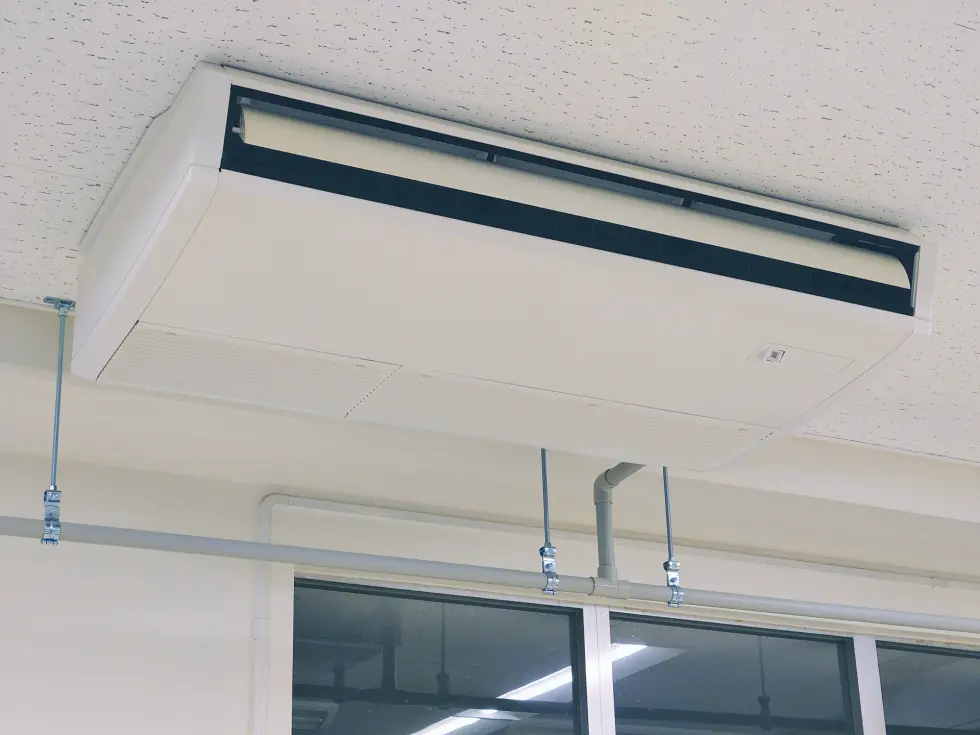
| Restaurant / Salon | Ceiling-suspended / wall-mounted / kitchen-use | Suitable for spaces without ceiling cavities; kitchen models resist oil contamination. |
| Factory / Warehouse | Floor-standing / spot air conditioners | Efficient for high ceilings or localized cooling. |
Especially in Hamamatsu factories, selecting airflow and installation methods suited to the space is essential.
3.2 Energy Efficiency and Environmental Considerations
Commercial air conditioners consume large amounts of electricity, so choosing energy-efficient models is strongly recommended.
Compared to models over 10 years old, modern units can significantly reduce power consumption, and overall costs may decrease due to lower electricity bills even when paying lease fees.
Environmentally friendly models using low-GWP refrigerants (e.g., R32) are increasingly adopted.
3.3 Comparison of Major Manufacturers
| Manufacturer | Features |
|---|---|
| Daikin | Top domestic share, high reliability, advanced airflow control technology. |
| Mitsubishi Electric | “Move Eye” sensor enables efficient and comfortable air conditioning. |
| Hitachi | Known for “freeze cleaning” technology to maintain cleanliness. |
| Panasonic | Equipped with “nanoe X” for air purification and deodorization. |
Choose the most cost-effective model by matching each manufacturer’s unique features with your business needs.
4. Costs and Breakdown of Commercial Air Conditioner Leasing in Hamamatsu
When introducing commercial air conditioners in Hamamatsu City, more businesses are choosing leasing rather than purchasing.
When considering a lease contract, the most important concern is the cost structure.
Here, we подробно explain the breakdown of initial costs and monthly lease fees, repair and maintenance costs during operation, and subsidy programs to reduce the financial burden.
4.1 Structure of Initial Costs and Monthly Lease Fees
The biggest advantage of leasing commercial air conditioners is that you can reduce large upfront costs (equipment and installation) to zero.
In the case of purchase, several million yen may be required upfront, but leasing allows you to introduce the latest air conditioner with only fixed monthly payments.
The monthly lease fee typically includes the following:
- The cost of the commercial air conditioner unit
- Standard installation costs
- Comprehensive movable property insurance during the lease period (covering natural disasters such as fire, lightning, and flooding)
- Taxes such as fixed asset tax and movable property tax
The approximate monthly lease fees for commonly used commercial air conditioners in offices and stores in Hamamatsu are as follows.
Prices vary depending on the lease period (typically 4–7 years) and horsepower.
| Air Conditioner Type (Horsepower) | Suitable Facility Example | Monthly Lease Fee (5–7 year lease) |
|---|---|---|
| Wall-mounted / Ceiling cassette (1.5–3 HP) | Small shops / small offices | Approx. ¥6,000 – ¥12,000 |
| Ceiling cassette / Ceiling-suspended (4–6 HP) | Medium-sized offices / restaurants | Approx. ¥13,000 – ¥20,000 |
| Floor-standing / Duct type (8–10+ HP) | Factories / large warehouses / supermarkets | Approx. ¥25,000 – ¥40,000 |
These are general estimates, and additional installation costs may be added depending on conditions in Hamamatsu (e.g., piping length or special scaffolding).
4.2 Repair and Maintenance Costs
One important point in lease contracts is that repair costs and regular maintenance costs (such as cleaning) are generally not included in the monthly lease fee.
In typical finance lease contracts, repair costs in case of failure are borne by the user.
However, to avoid unexpected repair expenses, many leasing companies and manufacturers offer “warranty-included leases.”
With such plans, repair costs and parts for natural failures during the lease period (up to around 10 years) are covered.
In Hamamatsu, where air conditioners are heavily used during hot summers, restaurants and factories often choose warranty plans to stabilize running costs.
Maintenance costs such as filter cleaning and internal washing are usually separate.
Some Hamamatsu leasing companies offer maintenance packages, so it is important to confirm what is included in the estimate.
4.3 Utilizing National and Local Subsidy Programs
Another way to reduce the cost of introducing commercial air conditioners is to utilize subsidy programs offered by national and local governments.
When replacing old units with energy-efficient models, subsidies may apply even for lease contracts.
For example, energy-saving subsidy programs led by the Ministry of the Environment or METI support upgrades to high-efficiency equipment.
Details can be checked on the Ministry of the Environment official website.
Additionally, Hamamatsu City and Shizuoka Prefecture may offer independent support programs for SMEs and decarbonization initiatives.
Since subsidies often end once budgets are exhausted, it is advisable to consult early with local contractors experienced in subsidy applications.
5. Process from Lease Contract to Installation
When introducing commercial air conditioners via leasing in Hamamatsu, understanding the process in advance is essential for smooth operations.
Here, we explain each step from consultation to installation and handover.
5.1 Consultation, Site Survey, and Model Selection
The process begins with contacting HVAC contractors or leasing companies serving the Hamamatsu area.
The optimal air conditioner capacity and type vary depending on the installation environment (store, office, factory, etc.).
Therefore, a site survey by professional staff is an essential process.
During the survey, building structure, size, heat sources, and piping routes are carefully examined.
Based on this, the most suitable model is proposed from major manufacturers such as Daikin, Mitsubishi Electric, and Panasonic.
At this stage, an approximate estimate of initial costs and monthly lease fees is usually provided.
5.2 Lease Screening and Contract Signing
Once you agree on the model and estimate, the next step is application and screening by the leasing company.
Lease contracts require approval from leasing or finance companies.
The general process and required documents are as follows:
| Step | Details / Required Documents |
|---|---|
| 1. Lease Application | Application form, company profile, financial statements (2–3 periods), ID of representative |
| 2. Screening | Usually completed within 1–3 business days; additional documents may be required for new companies |
| 3. Contract Signing | Sign and seal the lease agreement after approval |
During screening, business continuity and financial condition are evaluated, so preparing documents in advance is important.
5.3 Installation and Handover in Hamamatsu
After signing the lease, installation scheduling begins.
Local contractors familiar with Hamamatsu conditions ensure efficient and careful work.
Installation typically involves:
Removal of existing units and refrigerant recovery
Installation of new indoor/outdoor units
Piping and electrical work
For small offices or stores, installation is usually completed within 1–2 days.
After completion, test operation is conducted to ensure proper performance, no abnormal noise, and no water leakage.
Finally, instructions on operation and maintenance are provided, and the system is handed over.
The lease period officially begins upon signing the acceptance certificate at handover.
6. Operation and After-Sales Service After Leasing
Commercial air conditioners require proper operation and maintenance throughout the lease period.
In regions like Hamamatsu with high cooling demand in summer, daily operation and after-sales support directly impact equipment lifespan and running costs.
6.1 Regular Maintenance and Troubleshooting
Regular maintenance is essential for efficient long-term operation.
Neglecting filter cleaning and internal washing reduces efficiency, increases electricity costs, and causes breakdowns.
Lease types include:
Maintenance-included lease (repairs covered)
Standard lease (repairs at user expense)
More businesses are choosing maintenance-included leases to mitigate unexpected failure risks.
Quick response support in Hamamatsu is especially important during peak seasons.
6.2 Refrigerant Management and Legal Compliance
Businesses must comply with the Fluorocarbon Emission Control Act.
This law requires proper management, inspections, and leak prevention.
There are two types of inspections:
| Inspection Type | Target Equipment | Frequency | Performer |
|---|---|---|---|
| Simple Inspection | All specified equipment | At least once every 3 months | Manager (in-house staff) |
| Periodic Inspection | Equipment ≥7.5kW | Annually or every 3 years | Certified professional |
Records must be stored even after disposal.
Partnering with maintenance providers that support compliance and refrigerant management is essential.
7. Summary
Leasing commercial air conditioners in Hamamatsu is an optimal option for many businesses, allowing the introduction of energy-efficient models without high upfront costs.
Choosing reliable manufacturers like Daikin and Mitsubishi Electric enables significant energy savings and comfortable environments.
When selecting contractors, choose local, reliable providers with strong support and compliance capabilities.
Always compare multiple quotes, including maintenance services—not just monthly fees.
Also consider subsidies to secure the best lease contract for your business.