
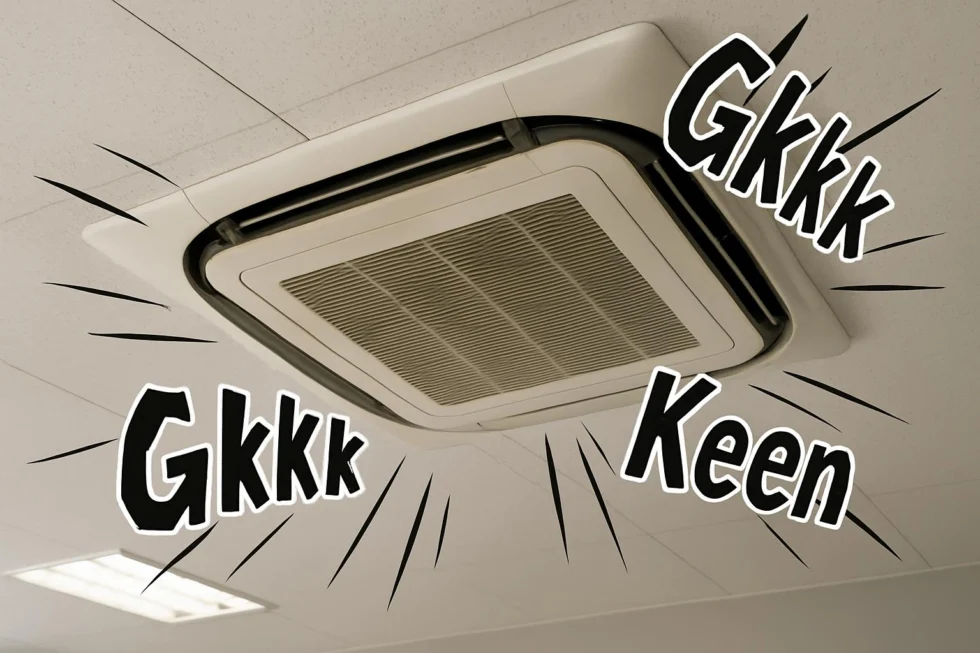
Are you experiencing issues in offices, restaurants, factories, or other facilities in Hamamatsu such as “a rattling or high-pitched noise coming from a commercial air conditioner” or “it suddenly became noisy, but we cannot stop it because it would affect business operations”?
In this article, we clearly explain from a professional perspective what are the common causes of abnormal noises in commercial air conditioners in the Hamamatsu area, how much repair costs typically are, and which type of repair contractor you should consult.
We will organize and explain common causes of noise such as dirt or clogging in filters and fans, deterioration of motors and compressors, refrigerant gas shortages or piping issues, installation defects, and loose parts. We’ll also cover estimated repair costs for each issue, a breakdown of fees such as service and inspection charges, and tips for reducing costs.
Additionally, we introduce key points to check when choosing a commercial air conditioner repair company in Hamamatsu—such as experience and track record, pricing transparency, and after-sales support—as well as simple on-site troubleshooting steps and the importance of regular maintenance to prevent problems.
By reading this article, you will gain a clear understanding of whether the noise requires immediate action, when to call a professional, and what level of cost to expect—helping you confidently consult a reliable repair service in Hamamatsu.

Based in Hamamatsu, we specialize in the design, installation, and maintenance of commercial air conditioning, HVAC, and pump systems.
With over 30 years of proven experience and technical expertise, we help create comfortable environments.
Trusted by many publicly listed companies, we take pride in our reliability and responsive service.
We also operate a branch in Malaysia, expanding our reach globally.
Learn more about our company
Contents
- 1. Peace of Mind in Leaving Commercial Air Conditioner Noise Issues in Hamamatsu to Professionals
- 2. A Thorough Explanation of the Common Causes of Abnormal Noises in Commercial Air Conditioners
- 3. Repair Costs and Breakdown for Commercial Air Conditioner Noise Issues in Hamamatsu
- 4. Key Features of Commercial Air Conditioner Repair Companies to Choose in Hamamatsu
- 5. Emergency Measures and Preventive Strategies for Abnormal Noise in Commercial Air Conditioners
- 5.1 What to Do First When You Notice Something Unusual
- 5.2 Importance of Regular Maintenance
- 5.2.1 1. Recommended Frequency for Filter Cleaning and Simple Inspection
- 5.2.2 2. Importance of Professional Inspection and Disassembly Cleaning
- 5.2.3 3. Optimize Installation Environment to Reduce Noise Risk
- 5.2.4 4. Reduce Load with Proper Temperature Settings and Operation
- 5.2.5 5. Establish Internal Reporting System for Abnormal Noise
- 6. Summary
1. Peace of Mind in Leaving Commercial Air Conditioner Noise Issues in Hamamatsu to Professionals
Commercial air conditioners used in offices, restaurants, factories, clinics, and other facilities in Hamamatsu are often operated for long hours under high load, making them more prone to abnormal noises.
If such noises are left unattended with the assumption that “they will eventually stop,” they may lead to sudden breakdowns or the complete loss of cooling and heating functions, potentially causing significant impacts on sales and operations.
Therefore, consulting a professional with expertise in commercial air conditioners in the Hamamatsu area at the stage when you first notice abnormal noise is ultimately the most reliable way to reduce costs while extending the lifespan of your equipment.
The greatest advantage of hiring a professional is not simply to “stop the noise,” but to accurately identify the root cause, prevent recurrence, and ensure that store or office operations are not disrupted.
Diagnosis based on specialized knowledge, proper tools, and manufacturer-specific structural understanding cannot be replicated through guesswork or by inexperienced technicians.
1.1 Identifying the Cause with Specialized Knowledge and Technology
Abnormal noises from commercial air conditioners can vary widely, including “low rumbling sounds,” “rattling or vibrating noises,” “high-pitched metallic sounds,” and “hissing sounds that may indicate gas leaks.”
Professionals who inspect and repair commercial air conditioners in Hamamatsu possess advanced diagnostic skills that combine multiple factors such as the type of sound, timing of occurrence, installation environment, equipment age, and manufacturer to accurately determine the cause.
In particular, commercial air conditioners such as ceiling cassette types and ducted systems have structures that differ significantly from residential units, making it difficult to identify whether the issue lies in the indoor unit, outdoor unit, or piping.
Professionals investigate the cause from the following perspectives using service manuals and specialized measuring instruments:
| Diagnostic Perspective | Specific Checks | Possible Issues |
|---|---|---|
| Type of noise | Determine whether it is a rumbling rotational sound, a rattling contact sound, or a high-pitched metallic noise | Fan motor malfunction, bearing wear, interference between metal components, etc. |
| Timing of occurrence | Check whether the noise occurs during startup, shutdown, cooling, heating, or defrost operation | Compressor startup failure, four-way valve malfunction, outdoor fan imbalance, etc. |
| Installation condition | Check ceiling materials, mounting base condition, outdoor unit placement and fixation, and presence of vibration-prone materials | Amplified vibration due to poor installation, insufficient pipe fixation, building resonance noise, etc. |
| Age and usage environment | Check years of use, maintenance history, presence of oil smoke or dust, usage hours, and load conditions | Wear due to aging, fan imbalance caused by oil contamination, clogged heat exchangers, etc. |
In this way, professional diagnosis is not about roughly guessing the source of the noise, but rather a systematic process of identifying the cause based on expertise in structure, electrical circuits, and refrigerant cycles.
As a result, it becomes possible to accurately determine whether parts replacement is necessary, whether cleaning or tightening will resolve the issue, or whether piping work is required.
Furthermore, commercial air conditioners differ by manufacturer and series in terms of error code displays and control logic.
Professionals are familiar with the specifications of major domestic manufacturers such as Daikin, Hitachi, Mitsubishi Electric, and Panasonic, and can identify the source of abnormal noise while assessing how much load is being applied to each component based on error messages and operating conditions, which provides great peace of mind.
1.2 Fast and Safe Repair Response
In regions like Hamamatsu, where summers are hot and humid, issues with commercial air conditioners can often become urgent situations.
Especially in restaurants, factories, and medical facilities, deterioration of the indoor environment directly affects customer satisfaction, work quality, and safety.
By hiring a professional, the entire process—from arrival on-site to diagnosis, temporary measures, and full repair—proceeds smoothly, minimizing downtime.
Additionally, commercial air conditioners contain hazardous components such as high-voltage parts, high-temperature areas, and refrigerant piping, which can lead to accidents such as electric shock, fire, or refrigerant leakage if handled improperly.
Professionals are trained through qualifications such as electrical certifications and manufacturer training, and carry out work with attention to the following points:
| Safety Benefits of Hiring Professionals | Details |
|---|---|
| Avoidance of electric shock and leakage risks | Following proper breaker shutdown procedures and voltage checks, and using insulated tools and protective equipment to prevent electrical accidents |
| Proper handling of refrigerant gas | Using recovery machines and vacuum pumps to prevent releasing refrigerant gas into the atmosphere, avoiding environmental impact and legal violations |
| Safe management of high-altitude and ceiling work | Ensuring safe ladder and scaffold setup and proper access through ceiling openings to prevent falls and damage |
| Prevention of fire and smoke | Inspecting wiring connections and insulation conditions to eliminate causes of abnormal heat generation and reduce fire risks |
Furthermore, by hiring professionals, you can often receive warranties on repair work and replacement parts, allowing for free or discounted service if the same issue reoccurs within a certain period, which provides additional peace of mind.
This helps reduce concerns such as “what if it breaks again soon after being repaired.”
On the other hand, attempting to fix the issue yourself—such as removing covers or forcibly moving fans and piping—may damage existing components, leading to more expensive repairs than originally necessary.
In particular, ceiling-embedded indoor units and building multi systems have complex structures with intricate wiring and piping, so it is best to avoid attempting DIY fixes and instead have a professional inspect the condition early, which ultimately saves both time and cost.
When abnormal noise occurs in a commercial air conditioner in Hamamatsu, entrusting the issue to professionals who can respond flexibly based on local conditions, building structures, and business operations makes it easier to create an environment where you can focus on your daily work with peace of mind.
2. A Thorough Explanation of the Common Causes of Abnormal Noises in Commercial Air Conditioners
Commercial air conditioners used in office buildings, stores, factories, and other facilities in Hamamatsu are often operated continuously for long hours, and if proper maintenance is neglected, they become more prone to various abnormal noise issues.
Here, we will organize the representative causes that are frequently discussed on-site and explain in detail the points that should be checked for each type of sound.
If a commercial air conditioner that is producing abnormal noise continues to be operated forcefully, there is a risk of leading to more serious failures and business disruptions, such as damaged parts, electrical leakage, or shutdown of the outdoor unit.
If you feel that something is even slightly wrong, it is important to identify the cause early and request professional inspection and repair.
| Examples of Sounds You May Hear | Main Location of Occurrence | Examples of Suspected Causes |
|---|---|---|
| A roaring or humming sound | Outdoor unit / indoor unit | Dirty fan, increased motor load, compressor deterioration |
| Rattling or clattering sound | Indoor unit / ceiling cassette / duct | Fan imbalance, loose components, improper installation |
| High-pitched whining or squealing sound | Outdoor unit / around the piping | Refrigerant gas flow noise, abnormal pressure, valve malfunction |
| Gurgling or dripping sound | Drain piping / indoor unit | Drain clogging, stagnant condensation water, poor pipe slope |
2.1 Dirt and Clogging in Filters and Fans
The most common and easiest-to-detect cause of abnormal noise is dirt or clogging caused by dust, oil, cigarette tar, and other buildup on filters and fans.
Special care is required in environments with a lot of dust or oily smoke, such as restaurants, factories, and beauty salons.
2.1.1 Wind-Cutting and Humming Noises Caused by Dirty Filters
Commercial air conditioners such as ceiling cassette and built-in types condition spaces by taking in and expelling large volumes of air.
When the filter becomes clogged, the blower fan rotates more forcefully to secure the necessary airflow, making the following symptoms more likely to appear.
- The blower noise becomes louder than usual, producing a roaring or humming sound
- When the airflow setting is increased, the wind-cutting noise becomes stronger near the indoor unit
- The airflow is weak and heating/cooling performance is poor, yet only the fan noise is loud
In many cases, these symptoms indicate abnormal noises that can be expected to improve through filter cleaning or internal disassembly cleaning of the indoor unit.
On sites with many units, such as entire buildings or large stores, managing a regular filter cleaning schedule becomes especially important.
2.1.2 Dirt on Fans and Sirocco Fans and Resulting Imbalance
When dirt accumulates on fans installed in commercial air conditioner indoor or outdoor units, such as propeller fans or sirocco fans, the weight balance is disrupted, causing vibration and leading to abnormal noises such as the following.
- Rattling or shaking vibration noises when operation starts or just before stopping
- Periodic humming or buzzing noises at a certain rotation speed
- The indoor ceiling or ducts resonate, making it feel as if the entire building is shaking
Even if the dirt on the fan appears minor, once centrifugal force is applied, it can create a significant imbalance.
If left untreated, it increases the load on the motor and may lead to serious failures such as motor burnout or bearing damage, so disassembly cleaning and balance adjustment by a professional contractor are recommended.
2.1.3 Abnormal Noises Caused by Oil Contamination Common in Restaurants and Factories
When an indoor unit is installed near a kitchen, such as in yakiniku or Chinese restaurants, air containing a large amount of oily smoke passes through the filter and accumulates as sticky contamination on the heat exchanger (aluminum fins) and fan.
This can produce the following characteristic abnormal noises.
- The fan does not rotate smoothly and makes a dragging or catching sound due to sticky contamination
- Intermittent contact noises such as rattling or clattering occur during operation
- During heating operation, there may be a burnt smell and a faint crackling sound from the heat exchanger
In such environments, commercially available simple spray cleaning is often insufficient, and full-scale disassembly cleaning using a high-pressure washer, along with introducing grease filters or reviewing their replacement frequency is effective.
2.2 Deterioration and Failure of Motors and Compressors
Compared with dirt on filters and fans, abnormal noises caused by deterioration or failure of electric motors or compressors are serious problems that can easily lead to expensive repairs if left unattended.
By paying attention not only to the volume of the sound but also to its quality and the timing of occurrence, it is possible to make a rough assessment.
2.2.1 Bearing Failure in the Blower Motor
The blower motors that rotate the fans of indoor and outdoor units contain bearings that support the shaft.
When these bearings wear out or run out of grease, the following abnormal noises may occur.
- Metallic scraping noises such as squeaking or squealing during operation
- As the rotation speed increases, it changes into a high humming noise or a continuous buzzing sound
- If you bring your ear close to the fan area, you may hear a regular rumbling rotation sound
When abnormal noise suggests bearing failure, temporary lubrication may reduce the noise for a short time, but in many cases, the fundamental solution requires parts replacement such as replacing the motor.
Continuing operation forcibly may lead to locking or burnout, so early inspection is important.
2.2.2 Abnormal Noise from the Compressor
The compressor installed in the outdoor unit is the heart of the air conditioning system, compressing and circulating refrigerant gas.
When an abnormality occurs inside the compressor, the following sounds may be heard.
- Metallic noises such as rattling or clanking immediately when operation starts
- A large vibration noise occurs only at the moment the compressor starts operating
- An abnormally heavy humming sound can be heard from the entire outdoor unit
These may be affected by wear or damage to internal parts, as well as insufficient refrigerant or insufficient oil.
Abnormal compressor noise is often a symptom for which replacing the entire outdoor unit may be considered rather than repair, depending on parts availability from the manufacturer and the age of the air conditioner.
2.2.3 Belt Deterioration in Belt-Driven Blowers
In some older buildings and large-scale air conditioning systems, belt-driven systems are used for duct blowers.
In such cases, belt deterioration or improper tension may cause the following abnormal noises.
- Squealing or slipping noises when starting up
- After operating for a certain period, there is a burnt rubber smell
- The airflow becomes unstable, and the wind becomes weaker or stronger along with the abnormal noise
Belts are consumable items and develop cracks and stretching over time.
Checking the degree of wear and tension during regular inspections and performing belt replacement or pulley adjustment as needed is key to preventing abnormal noise and maintaining airflow efficiency.
2.3 Refrigerant Gas Shortage and Piping Abnormalities
A characteristic abnormal noise unique to commercial air conditioners is a high-pitched sound such as hissing or whining heard near the outdoor unit or refrigerant piping.
This kind of sound tends to occur when there is an abnormality in the flow or pressure of the refrigerant gas.
2.3.1 Sounds and Symptoms Commonly Seen When Refrigerant Gas Is Low
When refrigerant gas is insufficient, not only does performance decline, such as poor cooling or heating, but the following sounds and behavior may also be observed.
- Immediately after startup, a hissing or rushing sound like something flowing through a narrow pipe becomes noticeable
- Near the outdoor unit, a periodic pressure fluctuation sound such as a “psshh” may be heard
- During cooling operation, the heat exchanger of the indoor unit partially freezes, and water sounds or cracking sounds occur as the ice melts
In many cases, insufficient refrigerant gas is a sign that refrigerant is leaking somewhere.
If simple gas refilling is repeated, the leakage point may worsen and the load on the compressor may also increase, so inspection and repair of the piping, flare connections, and areas around valves are essential.
2.3.2 Abnormal Noises Caused by Clogging or Foreign Matter in the Piping
In commercial air conditioners that have been used for a long time, sludge, moisture, and impurities can accumulate inside the refrigerant piping, making it easier for clogging to occur.
In such cases, the following phenomena may occur.
- Fine noises such as rattling or crackling can be heard from inside the piping in sync with compressor operation
- Part of the piping may become abnormally cold or more prone to condensation or frost
- The refrigerant flow becomes unstable, increasing the load on the outdoor unit and causing a loud humming noise
If piping clogging is suspected, pressure measurement using specialized equipment, piping cleaning, and if necessary, partial or complete replacement of the piping may be considered.
Since incorrect construction or mixing different refrigerants can cause serious trouble, construction and repair must always be performed by qualified technicians.
2.3.3 Sounds Around Drain Piping and Condensation Water
Although not directly related to refrigerant itself, the flow or clogging of condensation water generated during cooling operation is also a common cause of abnormal noise.
In particular, with ceiling cassette and built-in types, there are many consultations about the following sounds.
- During operation, a bubbling sound such as gurgling or glugging may be heard
- A dripping sound of water droplets falling can be heard from around the panel of the indoor unit
- When the drain pump operates, there may be a vibration sound or a buzzing drive sound
These are often caused by poor drain pipe slope, clogging, or deterioration of the drain pump, and if left untreated, may lead to secondary damage such as water leakage from the ceiling, corrosion of interior materials, or mold growth.
2.4 Poor Installation and Loose Components
Construction defects during installation, as well as looseness of components due to long-term vibration and aging, are also causes of abnormal noise in commercial air conditioners that should not be overlooked.
These are especially important points to watch in tenant buildings and factories in Hamamatsu, where building structures, installation environments, and the number of units tend to be substantial.
2.4.1 Vibration Noise Caused by Poor Installation of Indoor and Outdoor Units
Commercial air conditioners are heavy, and vibration always occurs during operation.
If the installation surface is not level or anti-vibration rubber is not properly installed, that vibration is transmitted to the building and appears as abnormal noises such as the following.
- Resonance noises such as buzzing or creaking from the ceiling material around a ceiling cassette unit
- Continuous knocking or rattling sounds near an outdoor unit installed on a rooftop or on the ground
- Complaints from neighboring tenants or offices that “vibration noise is coming through the walls or ceiling”
In such cases, it is necessary to comprehensively review the installation conditions, including the condition of anchor fixation, the strength of the mounting frame, the presence of anti-vibration rubber or pads, and the condition of piping support brackets.
Since simply tightening screws often does not solve the problem, confirmation by a professional installation contractor is essential.
2.4.2 Poor Fixing of Panels or Ducts and Loose Screws
Due to vibration from many years of operation, as well as earthquakes or strong winds, fixed parts such as indoor unit panels, ducts, and louvers may become loose.
In such cases, the following abnormal noises can occur.
- When the airflow is increased, part of the panel flaps noisily
- The metal duct is blown by the airflow and makes a clanging noise
- The louvers around the air outlet shake in a small rattling motion
Abnormal noises from panels or ducts may seem like relatively minor problems, but if left unattended, they can lead to safety risks such as screws falling out or panels dropping.
It is important to identify the location where the abnormal noise is occurring and check and reinforce the fixing condition.
2.4.3 Interference Noise from Piping and Cables
If piping, electrical wires, or wiring ducts around indoor and outdoor units come into contact with the building frame or other equipment, vibration during operation can cause the following abnormal noises.
- During operation, light knocking sounds such as tapping or knocking can be heard from inside walls or above the ceiling
- Vibration noise increases only in certain operating modes, such as under high-load operation
- As anti-vibration materials deteriorate, there may be a sound as if metal pipes are directly hitting each other
Such interference noises can often be improved by reviewing the support method and fixing position of piping and cables and carrying out measures such as adding cushioning materials, adjusting bracket positions, or changing the piping route.
Particular care is required in cases where existing piping is reused during replacement work or where equipment from multiple manufacturers is combined at the same site.
3. Repair Costs and Breakdown for Commercial Air Conditioner Noise Issues in Hamamatsu
In Hamamatsu City, when abnormal noise occurs in a commercial air conditioner, repair costs vary significantly depending on the “cause” and the “type of unit” (ceiling cassette, ceiling-suspended, floor-standing, building multi system, etc.).
Here, we will clearly organize typical cases frequently requested and provide an easy-to-understand overview of cost estimates and their breakdown.
Actual costs vary depending on the air conditioner manufacturer (Daikin, Mitsubishi Electric, Hitachi, Toshiba, Panasonic, etc.), installation conditions, and the severity of the issue, so please consider these as general reference ranges.
3.1 Estimated Repair Costs by Cause of Noise
Abnormal noise in commercial air conditioners can stem from causes such as “dirt and clogging,” “component deterioration or damage,” “refrigerant system issues,” and “installation defects or loose parts,” each requiring different work and parts.
Below are examples of commonly seen abnormal noise issues in the Hamamatsu area along with approximate cost ranges.
| Main Cause of Noise | Typical Work Required | Estimated Cost (Tax Included) | Notes |
|---|---|---|---|
| Dirty filters, heat exchanger, or fan | Filter cleaning, heat exchanger washing, cleaning around the fan | Approx. ¥10,000–¥30,000 | Applies when contamination is minor and no parts replacement is needed. Varies by number of units and installation height. |
| Fan imbalance or deformation | Fan disassembly inspection, balance adjustment, fan replacement if necessary | Approx. ¥20,000–¥60,000 | Costs tend to increase for ceiling cassette or suspended units due to ceiling opening and protective work. |
| Motor (fan motor) deterioration or failure | Motor inspection, bearing check, motor replacement | Approx. ¥30,000–¥90,000 | Three-phase power units or large-capacity systems tend to have higher parts costs. |
| Abnormal noise around the compressor | Compressor inspection, piping vibration check, compressor replacement | Approx. ¥80,000–¥300,000+ | Compressor replacement is expensive and varies greatly depending on age and capacity. |
| Refrigerant shortage or leakage | Refrigerant pressure check, leak detection, brazing repair, vacuuming, refrigerant recharge | Approx. ¥30,000–¥120,000 | Costs vary depending on refrigerant type (R410A, R32, etc.) and leak location/length. |
| Vibration or resonance of piping/support fittings | Re-fixing piping, adding/replacing anti-vibration rubber or fittings | Approx. ¥15,000–¥50,000 | Common in rooftop or wall-mounted outdoor units; may increase with high-altitude work. |
| Abnormal noise from drain pump | Drain pump inspection, clog removal, pump replacement | Approx. ¥20,000–¥70,000 | Common with ceiling cassette units; prompt action needed if accompanied by water leakage. |
| Loose panels, ducts, or ceiling materials | Panel adjustment, screw tightening, simple vibration control measures | Approx. ¥10,000–¥40,000 | May occur after interior renovations in stores. |
Even with similar noises such as “rattling” or “roaring,” the required work differs greatly depending on the cause.
Therefore, when requesting repair for abnormal noise in Hamamatsu, providing detailed information such as the type of sound, timing, model name, and age during initial contact makes it easier to receive an accurate estimate.
Also, if the air conditioner is still under warranty, repairs may be free or discounted depending on manufacturer warranty, extended warranty, or maintenance contracts, so checking documentation is very important.
For rental properties, repair costs may be covered by the building owner or management company, so confirm in advance whether it will be your responsibility.
3.2 Travel Fees and Inspection Costs
When requesting repair services in Hamamatsu, many companies charge “travel fees” and “inspection/diagnosis fees” separately from repair costs.
Since the cause of abnormal noise is not always immediately identifiable, it is common to conduct an inspection first and then provide a full repair estimate based on the findings.
| Item | Description | Estimated Cost (Tax Included) | Notes |
|---|---|---|---|
| Travel fee | Transportation cost to the site within Hamamatsu City | Approx. ¥3,000–¥8,000 | Additional charges may apply for areas outside Hamamatsu (Iwata, Kosai, Fukuroi, etc.). |
| Inspection/diagnosis fee | Inspection of the air conditioner, outdoor unit, and piping to identify the cause | Approx. ¥5,000–¥15,000 | May increase with multiple units; sometimes free under maintenance contracts. |
| Minor adjustment only | Noise resolved with simple tightening or cleaning | Approx. ¥5,000–¥20,000 | Often billed as part of inspection work with prior explanation. |
| Estimate preparation fee | Detailed quotation for major repairs or parts replacement | Free–Approx. ¥5,000 | Often free, but may be charged if on-site inspection is required. |
Confirm in advance whether travel and inspection fees will be discounted or waived if you proceed with the repair, so you can better understand the total cost.
When inspecting multiple units at once, the cost per unit may decrease, making bulk inspections more economical than individual service calls.
Note that in special environments such as rooftop outdoor units requiring aerial work vehicles or large facilities like shopping malls and factories, additional costs such as high-altitude work fees, night work fees, and parking fees may apply.
In areas around Hamamatsu Station or busy commercial districts, costs may also vary depending on parking availability and work-hour restrictions, so sharing site photos in advance can help streamline communication.
3.3 Tips to Reduce Costs
While repair costs for commercial air conditioner noise can be high, following key points can help minimize unnecessary expenses while resolving issues safely.
From a cost management perspective for stores and offices in Hamamatsu, the following measures are useful:
3.3.1 1. Request Inspection Early to Prevent Major Issues
Requesting inspection at an early stage—such as when you notice slight rattling or noise only during startup—is the most effective way to keep costs low.
If left unattended, problems may escalate as follows:
- Fan imbalance → increased load on shaft/bearings → motor failure → costly motor replacement
- Refrigerant leak → overload on compressor → compressor failure → expensive replacement
- Piping vibration → metal fatigue/cracks → refrigerant leakage or water leakage
At an early stage, cleaning or minor adjustments may resolve the issue without requiring parts replacement.
3.3.2 2. Utilize Maintenance Contracts
For businesses operating multiple units, such as restaurants, salons, and offices, signing a maintenance contract for 1–2 inspections per year can reduce failure frequency and lower long-term costs.
Typical maintenance includes:
- Cleaning of filters, heat exchangers, drain pans, and fans
- Electrical system inspection (terminal tightening, insulation checks)
- Refrigerant pressure checks and noise/vibration inspection
- Minor adjustments and tightening work
With a maintenance contract, travel and inspection fees may be discounted, and priority support may be provided in case of breakdowns.
3.3.3 3. Compare Repair vs Replacement
Depending on the cause, replacing the entire unit may be more cost-effective in the long run than expensive repairs such as compressor or control board replacement.
Consider replacement if:
- The unit has been in use for over 10 years
- There is a history of repeated repairs
- Cooling/heating performance is poor and energy costs are high
- Multiple symptoms such as noise, odor, and water leakage are present
Upgrading to a modern energy-efficient unit can lead to lower electricity costs, reduced failure risk, and improved indoor comfort.
3.3.4 4. Obtain Multiple Quotes
Even for the same repair, costs can vary depending on labor, parts, travel fees, and additional charges set by each contractor.
For expensive repairs such as compressor replacement or piping work, it is advisable to compare multiple quotes.
Check not only the price but also:
- Whether the estimate clearly lists work details and parts
- Whether warranty and after-service terms are specified
- Whether conditions for additional charges are explained
3.3.5 5. Maintain Daily Care In-House
Finally, regular cleaning and simple checks can significantly reduce the risk of abnormal noise. For example:
- Clean filters regularly according to the manual
- Keep intake and outlet areas free of dust and debris
- Avoid placing objects around the unit and ensure proper airflow
- Record any unusual symptoms such as noise, odor, or leaks
Daily care can help prevent costly repairs.
However, since electrical work and refrigerant handling require licensed professionals, do not attempt such tasks yourself and consult a professional in Hamamatsu promptly for both safety and cost efficiency.
4. Key Features of Commercial Air Conditioner Repair Companies to Choose in Hamamatsu
There are many companies in Hamamatsu that can handle abnormal noise issues in commercial air conditioners, but the choice of contractor can greatly affect the “accuracy of diagnosis,” “repair costs,” and “length of downtime.”
In particular, since commercial air conditioners used in stores, offices, and factories directly impact sales and operations if they stop, choosing a repair company with proven experience, strong technical capability, and clear pricing—rather than simply choosing the nearest one—ultimately leads to cost savings and peace of mind.
Here, we will explain in detail the key points you should always check when selecting a repair company for commercial air conditioner noise issues in the Hamamatsu area.
4.1 Extensive Experience and Proven Track Record
Commercial air conditioners come in various forms such as ceiling cassette, ceiling-suspended, floor-standing, and built-in types, and manufacturers include Daikin, Mitsubishi Electric, Hitachi, Toshiba, and Panasonic.
In addition, system configurations such as individual air conditioning, multi air conditioners, and building multi systems are complex.
Therefore, whether the company has extensive experience handling various models, installation environments, and equipment ages directly affects its ability to accurately identify the cause of abnormal noise.
Check how much “installation track record” and “inspection/maintenance track record” is presented on their website or company profile, and it is reassuring to confirm the following points.
4.1.1 Experience in Commercial Air Conditioners and Manufacturer Compatibility
Residential air conditioners and commercial air conditioners differ in structure, output, and maintenance methods.
If a company clearly states that it “specializes in commercial air conditioners” or has “extensive experience in installation and repair of commercial air conditioners”, it becomes easier for them to comprehensively determine whether the cause of abnormal noise lies in the fan, motor, compressor, drain pump, or piping vibration.
Also, check whether the following information is disclosed:
- Whether supported manufacturers (such as Daikin, Mitsubishi Electric, Hitachi, Toshiba, Panasonic, etc.) are clearly listed
- Whether the company is registered as an official service partner or authorized contractor for manufacturers
- Whether they handle a wide range of building types such as offices, restaurants, hospitals, care facilities, and factories
4.1.2 Track Record of Installation and Maintenance in the Hamamatsu Area
Even within Shizuoka Prefecture, Hamamatsu has environmental factors such as sea breeze, humidity, and industrial dust that can easily affect equipment.
A company with a track record of work across all areas of Hamamatsu—such as Naka Ward, Higashi Ward, Nishi Ward, Minami Ward, Kita Ward, Hamakita Ward, and Tenryu Ward—can be expected to provide inspection and repair services that take into account local environmental conditions.
Specifically, use the following points as a guideline:
- Whether the company has its headquarters, office, or service base in Hamamatsu
- Whether they present their track record with numbers, such as “over XX projects completed in Hamamatsu”
- Whether they list case studies involving local businesses, tenant buildings, or commercial facilities
| Check Item | What to Confirm | Key Point |
|---|---|---|
| Commercial air conditioner experience | Whether case studies and maintenance records are shown with photos or examples | Having examples categorized by use (stores, offices, factories) increases credibility |
| Supported manufacturers | Whether names like Daikin, Mitsubishi Electric, Hitachi, Toshiba, and Panasonic are clearly listed | If multiple manufacturers are supported, it is easier to consult even for older units |
| Local presence | Whether companies or facilities in Hamamatsu are introduced as part of their track record | Shorter travel time allows faster response to sudden failures or abnormal noise |
4.2 Clear Pricing and Detailed Explanations
When repairing abnormal noise in commercial air conditioners, multiple cost items arise, such as “travel fees,” “inspection/diagnosis fees,” “parts costs,” and “labor charges.”
If these are unclear, issues may arise where the estimate appears inexpensive at first but results in high charges after the work is completed.
Therefore, how clearly pricing is explained is extremely important when choosing a contractor.
4.2.1 Whether the Estimate Breakdown Is Easy to Understand
A reliable contractor will provide a clear breakdown of costs not only verbally but also in writing or via email.
In particular, check the following points:
- Whether travel and inspection fees are fixed or vary depending on distance and time
- Whether additional costs are explained when multiple causes of abnormal noise are involved
- Whether parts costs and replacement labor are listed separately when parts replacement is required
- Whether estimates are free or paid, and if paid, the amount and conditions are clearly stated
If an estimate only states “lump sum,” it can be difficult to judge its validity later, so caution is required.
If possible, ask for details on “which noise source will be addressed and what specific work will be performed.”
| Cost Item | Typical Description | What to Check |
|---|---|---|
| Travel fee | Basic cost for traveling within Hamamatsu or nearby areas | Whether additional charges apply for time (early morning, night, holidays) |
| Inspection/diagnosis fee | Cause investigation, operation check, and disassembly inspection | Whether the fee is discounted if repair work is requested afterward |
| Parts cost | Fan motors, compressors, belts, circuit boards, etc. | Whether parts are genuine, delivery time, and warranty availability |
| Labor cost | Parts replacement, piping repair, refrigerant recharge, cleaning work | Estimated work time and rules for additional charges |
4.2.2 Whether Technical Terms Are Explained Clearly
Explanations regarding abnormal noise in commercial air conditioners often include technical terms such as “inverter board,” “compressor,” “drain pump,” and “flare connections in refrigerant piping,” which may not be familiar to most people.
A contractor who explains these terms in an easy-to-understand manner and clearly communicates the necessity, urgency, and alternatives for repairs can be considered customer-oriented.
When receiving explanations, it is helpful to check the following:
- Whether they present multiple possible causes of the abnormal noise
- Whether they distinguish between “issues requiring immediate repair” and “issues that can be monitored and addressed later”
- Whether they explain the risks of not repairing (shutdown, leakage, increased electricity costs, etc.)
4.3 Strength of After-Sales Support
Commercial air conditioners do not end with a single repair; their condition changes depending on operation and environment afterward.
Since abnormal noise is often a precursor to failure, choosing a contractor with strong after-sales support and maintenance proposals leads to long-term stable operation and cost reduction.
4.3.1 Post-Repair Warranty and Response Speed
Reliable contractors often provide a warranty period for repaired parts.
Although the duration and coverage vary, check the following in advance:
- The warranty period and coverage for replaced parts or completed work
- Whether revisit costs apply if the same issue reoccurs
- Whether emergency contact is available only during business hours or also at night and on holidays
Also, since commercial air conditioners may suddenly stop or become noisy, a contractor that clearly indicates response time (e.g., within hours or days) for inquiries within Hamamatsu provides greater peace of mind.
4.3.2 Availability of Maintenance and Inspection Plans
After repairing abnormal noise, regular maintenance such as filter cleaning, internal washing, and electrical inspections can help prevent recurrence.
a contractor that offers not only one-time repairs but also annual inspections, seasonal checks, and regular cleaning services is easier to rely on as a long-term partner.
In particular, companies offering the following services tend to have strong after-sales support:
- Annual or biannual inspection plans (pre-cooling and pre-heating season checks)
- Disassembly cleaning services including filters and heat exchangers
- Preventive maintenance checks for abnormal noise, vibration, and current values
- Systems for recording maintenance history and providing consultation on replacement planning
| After-Sales Service | Benefit | Check Point |
|---|---|---|
| Repair warranty | Reduces additional costs if the same issue occurs again | Whether warranty period, scope, and exclusions are clearly stated |
| Regular inspections | Early detection of signs such as abnormal noise or vibration, preventing sudden shutdowns | Whether inspection details, frequency, and reporting are clearly defined |
| Cleaning services | Improves airflow noise and volume, and reduces electricity costs | Scope of disassembly, work time, and impact on business operations |
| Emergency response | Quick response to sudden noise worsening or system shutdown | Reception hours, service area, and estimated response time |
When dealing with abnormal noise in commercial air conditioners in Hamamatsu, comparing contractors based on “extensive experience,” “clear pricing and explanations,” and “strong after-sales support” will help minimize stress during issues and allow you to confidently entrust repairs.
5. Emergency Measures and Preventive Strategies for Abnormal Noise in Commercial Air Conditioners
When a commercial air conditioner starts making abnormal noise, it not only worsens the atmosphere of a store or office but may also lead to sudden breakdowns or business interruptions.
In restaurants, offices, and factories in Hamamatsu, where operating hours are long and equipment load is high, proper emergency responses when abnormal noise occurs, along with regular preventive maintenance are especially important.
5.1 What to Do First When You Notice Something Unusual
If you hear unusual sounds such as “rattling,” “high-pitched whining,” or “humming” from a commercial air conditioner, it is important not to touch it carelessly but to calmly assess the situation.
Here, we summarize the initial response steps that on-site personnel can safely perform.
5.1.1 1. Ensure Safety First and Check Operating Conditions
When abnormal noise occurs, the first priority is to ensure the safety of people and equipment.
Especially with ceiling-mounted or suspended indoor units, there is a possibility of falling parts or water leakage, so check the following:
| Check Item | Details | Action Guideline |
|---|---|---|
| Type of abnormal noise | Identify whether it is a metallic sound, scraping sound, rattling sound, or vibration noise | If possible, record it on a smartphone so it can be shared with the repair company |
| Timing of occurrence | Check whether it occurs only at startup, continuously during operation, or during cooling/heating | Take notes to explain clearly to the contractor |
| Visible abnormalities | Check for loose ceiling panels, condensation around piping, or abnormal vibration of the outdoor unit | If panels are loose, ensure no one stands directly underneath |
| Odor and heat | Check for unusual smells (burning odor) or excessive heat from the outdoor unit | If a burning smell is present, stop operation immediately, turn off the breaker, and contact a contractor |
5.1.2 2. Do Not Disassemble or Adjust Carelessly
Even if the cause of the abnormal noise appears to be something simple like loose screws or a dirty filter, commercial air conditioners are high-risk equipment involving electrical components, refrigerant piping, and elevated installations, so it is dangerous for untrained individuals to remove covers or panels.
The following actions should generally not be performed by on-site personnel:
- Removing panels of ceiling cassette indoor units and directly touching internal fans
- Removing outdoor unit covers and touching the fan or compressor area
- Moving refrigerant piping or electrical wiring, or adjusting fixtures
- Forcefully hitting or pressing suspected problem areas
These actions may cause electric shock or damage to components, and improper handling can worsen the issue, leading to higher repair costs.
5.1.3 3. The Only Safe Emergency Actions Are “Stop Operation” and “Restart”
The only safe emergency actions that can be performed on-site are basically temporarily stopping operation and attempting a restart after checking the situation.
Follow these steps and precautions:
- Stop operation using the remote controlDo not immediately unplug the unit or turn off the breaker; first stop operation using the normal procedure. Check if an error code is displayed and note it if present.
- Wait a few minutes before restartingIn cases of temporary control errors or frosting, the issue may resolve after some time. However, if loud abnormal noise continues after restarting, stop operation immediately.
- Check for abnormal noise after restartingEven if the noise disappears, it is not completely safe. The fact that abnormal noise occurred once is often a sign of internal deterioration or contamination, so it is advisable to request inspection as soon as possible.
5.1.4 4. If Noise Persists or Worsens, Contact a Professional Immediately
If the abnormal noise does not stop after restarting or gradually becomes louder, it is important to stop operation and request inspection and repair from a professional contractor without delay.
When making a repair request, providing the following information will help contractors in Hamamatsu understand the situation and respond more smoothly:
- Manufacturer name, model number, and installation year of the air conditioner
- Type of noise (e.g., squealing, rattling, vibration noise)
- Timing of occurrence (cooling or heating, startup or continuous operation)
- Presence and details of any error codes
- Whether filter cleaning or inspection was recently performed and when
5.2 Importance of Regular Maintenance
Many abnormal noise issues can be prevented in advance through regular inspection and cleaning.
In the Hamamatsu area, factors such as heavy traffic along major roads and industrial zones can cause dust and exhaust buildup, making air conditioners more prone to contamination.
In such environments, more frequent maintenance than usual may be necessary.
5.2.1 1. Recommended Frequency for Filter Cleaning and Simple Inspection
The most basic daily maintenance is filter cleaning.
When filters become clogged with dust, airflow is restricted, causing additional load on the blower fan and increasing the “whooshing” operation noise.
| Maintenance Item | Recommended Frequency | Key Points |
|---|---|---|
| Indoor unit filter cleaning | Once every 2–4 weeks (weekly to once every 2 weeks in restaurants or dusty environments) | Use a vacuum to remove dust; if washable, dry completely before reinstalling |
| Visual check of air outlet and intake | Once a month | Check for dust buildup or foreign objects around louvers |
| Cleaning around outdoor unit | At seasonal changes (3–4 times per year) | Ensure leaves, plastic, or cardboard are not blocking airflow |
Perform these tasks with the air conditioner turned off, and avoid reaching too far inside.
For ceiling-mounted units or high places, only perform work within a safe and reasonable range where stable footing is secured.
5.2.2 2. Importance of Professional Inspection and Disassembly Cleaning
Routine filter cleaning alone cannot fully remove mold and oil contamination from internal components such as the heat exchanger (aluminum fins), drain pan, and fan blades.
When these accumulate:
- The fan balance is disrupted, increasing vibration noises such as “humming” or “buzzing”
- The drain pump is overloaded, causing abnormal sounds like “buzzing” or “rattling”
- Heat exchange efficiency decreases, increasing compressor runtime and making the system noisier overall
To prevent these issues, regular professional inspection and disassembly cleaning, including refrigerant systems and electrical components, are highly effective.
Generally recommended inspection frequency:
- Light-use environments (restaurants/offices): annual inspection, disassembly cleaning every 2–3 years
- Heavy-use environments (greasy restaurants/factories): annual or more frequent cleaning, inspections every 6–12 months
Regular inspections check motor vibration, belt tension (for belt-driven systems), and piping fixation, allowing early detection of warning signs and preventive repairs before abnormal noise occurs.
5.2.3 3. Optimize Installation Environment to Reduce Noise Risk
The installation environment also affects the likelihood of abnormal noise.
Pay attention to outdoor unit conditions:
- Keep at least 30 cm of space around the outdoor unit to ensure proper airflow
- Avoid placing units on unstable or deteriorated stands, which can cause vibration resonance such as “thumping” or “buzzing” sounds
- Do not place objects on top of the outdoor unit
- Avoid hanging decorations near indoor air outlets that may create noise
5.2.4 4. Reduce Load with Proper Temperature Settings and Operation
Extreme temperature settings increase the load on compressors and fans, accelerating wear and causing abnormal noise.
For cooling operation:
- Set temperature around 26–28°C
- Avoid constant high fan settings; use auto or medium
- Avoid frequent on/off cycles and start operation early before opening
This helps reduce risks of compressor noise and fan motor humming.
5.2.5 5. Establish Internal Reporting System for Abnormal Noise
Finally, an effective preventive measure is to ensure all staff can quickly notice and report abnormal conditions.
In stores and restaurants, simple checks can be standardized:
- Listen for unusual operation sounds
- Check airflow consistency
- Look for signs of water leakage
Early detection allows repairs before major failures, minimizing costs and downtime.
In regions like Hamamatsu with high cooling demand in summer, daily awareness and communication are especially important.
6. Summary
If abnormal noise occurs from a commercial air conditioner in Hamamatsu and it is left unattended with the assumption that “it will fix itself,” it may develop into serious issues such as motor or compressor failure or refrigerant gas leakage, leading to high repair costs and potential business losses due to system downtime.
Therefore, it is important to consult a professional contractor as soon as you notice any unusual noise.
The main causes of abnormal noise vary widely, including dirt or clogging in filters and fans, deterioration of motors and compressors, insufficient refrigerant gas or piping issues, installation defects, and loose components.
Many of these issues require specialized knowledge and tools, and attempting to disassemble or repair the system based on self-judgment may worsen the damage or compromise safety.
For this reason, entrusting the entire process—from identifying the cause to completing the repair—to a professional provides peace of mind.
Repair costs can vary significantly depending on the cause of the noise and whether parts replacement is required. However, choosing a contractor who clearly presents a breakdown of costs—such as travel fees, inspection fees, parts costs, and labor charges—makes it easier to estimate the budget in advance.
Additionally, if addressed at an early stage through inspection and cleaning, many issues can be resolved at relatively low cost, meaning early action ultimately helps reduce expenses.
When selecting a commercial air conditioner repair company in Hamamatsu, it is important to ensure they have extensive experience in handling projects for stores, offices, and factories, provide clear and easy-to-understand estimates including explanations of any additional costs, and offer a reliable after-sales support system.
A contractor that meets these criteria can be trusted even in emergency situations.
As an emergency response when abnormal noise occurs, it is safest to stop operation while ensuring the breaker is properly handled, avoid unnecessary disassembly or cleaning, and request professional inspection.
In addition, performing regular filter cleaning and scheduling periodic inspections and maintenance by a professional contractor can help prevent abnormal noise and extend the lifespan of the air conditioning system.
Commercial air conditioners are essential equipment that support comfort and operational efficiency in stores and offices.
If abnormal noise begins to occur in Hamamatsu, focusing on the three key points—“early consultation,” “choosing a reliable contractor,” and “regular maintenance”—will enable safe operation of air conditioning systems, leading to long-term cost savings and a stable business environment.