
For those considering commercial air conditioner deep cleaning in Hamamatsu, this article clearly explains how mold, odors, oil contamination, and dust affect the air quality, electricity costs, and risk of breakdowns in stores, offices, and clinics.
It also comprehensively covers the details of the disassembly cleaning process, differences from regular cleaning, cost estimates, key points for choosing a contractor, and important considerations before making a request.
In conclusion, rather than leaving dirt unattended, performing regular deep cleaning by professional contractors is more effective for hygiene, energy efficiency, and equipment maintenance.

Based in Hamamatsu, we specialize in the design, installation, and maintenance of commercial air conditioning, HVAC, and pump systems.
With over 30 years of proven experience and technical expertise, we help create comfortable environments.
Trusted by many publicly listed companies, we take pride in our reliability and responsive service.
We also operate a branch in Malaysia, expanding our reach globally.
Learn more about our company
Contents
- 1. Hidden Risks in Commercial Air Conditioners in Hamamatsu: Problems Caused by Mold and Odors
- 2. What Is Commercial Air Conditioner Disassembly Cleaning? Thorough Professional Cleaning
- 3. Benefits of Requesting Commercial Air Conditioner Disassembly Cleaning in Hamamatsu
- 4. Key Points for Choosing a Contractor for Commercial Air Conditioner Disassembly Cleaning in Hamamatsu
- 5. Cost Estimates for Commercial Air Conditioner Disassembly Cleaning in Hamamatsu
- 6. Frequently Asked Questions: Commercial Air Conditioner Disassembly Cleaning in Hamamatsu
- 6.1 About Work Time and Frequency
- 6.2 What Types of Commercial Air Conditioners Are Supported?
- 6.2.1 What types of commercial air conditioners are supported?
- 6.2.2 Can you handle models from Daikin, Mitsubishi Electric, Hitachi, Panasonic, etc.?
- 6.2.3 Can old commercial air conditioners still be disassembly-cleaned?
- 6.2.4 Can I request service for models with automatic cleaning functions or other special features?
- 6.2.5 Should I request outdoor unit cleaning at the same time?
- 6.2.6 Can I request service for multiple units at once?
- 6.2.7 What information should I prepare for the estimate?
- 6.2.8 Will disassembly cleaning definitely eliminate odors and mold?
- 6.2.9 Can a malfunctioning commercial air conditioner still be cleaned?
- 6.2.10 Can I consult about payment methods and billing arrangements?
- 7. Summary
1. Hidden Risks in Commercial Air Conditioners in Hamamatsu: Problems Caused by Mold and Odors
If you operate a store, office, clinic, factory, or care facility in Hamamatsu, commercial air conditioners tend to run for long hours throughout the year, creating an environment where dust, oil, moisture, and condensation-related contaminants easily accumulate inside.
Even if there are no visible issues, once dirt builds up inside components such as heat exchangers, blower fans, drain pans, and deep within air outlets, problems such as musty odors, unpleasant smells, reduced airflow, and poor performance can occur.
In Hamamatsu, especially during periods of high cooling demand in summer, as well as in restaurants (oil smoke), beauty salons (chemicals and fine dust), medical and care facilities (strict hygiene requirements), and factories or workplaces (dust and high ventilation volumes), the way contaminants accumulate inside air conditioners varies depending on the industry.
Odors and mold are not just matters of discomfort but should be considered management issues that directly affect workplace environments, customer experience, hygiene management, and air conditioning efficiency.
1.1 What Happens If Left Untreated? Risks of Health Issues and Increased Electricity Costs
When dirt inside commercial air conditioners is left untreated, the first noticeable issue is often odor.
If you detect musty smells, mold-like odors, or damp smells when the unit starts operating, the cause may be contaminants or microorganisms inside.
If this condition continues, dissatisfaction with the air environment increases, potentially affecting the comfort of employees and customers.
Furthermore, when dirt accumulates on heat exchangers, filters, and fans, airflow becomes restricted, placing extra load on the system to reach the set temperature.
As a result, cooling and heating efficiency decreases, operating time becomes longer than necessary, and electricity costs are more likely to increase.
Even if you try to save energy by adjusting temperature settings, sufficient results may not be achieved if the interior is dirty.
Additionally, accumulated dirt increases the burden on components.
Clogged drain systems can cause poor drainage or water leaks, while increased load on fans and motors can lead to abnormal noise and higher risk of failure.
If the system stops suddenly during peak business periods, it can significantly disrupt operations, meaning that neglecting dirt does not reduce costs but may lead to substantial losses.
1.1.1 Common Problems Caused by Neglect
| Issue | Common Causes | Impact on Operations |
|---|---|---|
| Mold Odor / Unpleasant Smell | Accumulation of moisture, dust, oil, and dirt inside | Discomfort for customers and employees, reduced perception of hygiene |
| Poor Performance | Clogged heat exchangers and filters | Difficulty reaching set temperature, unstable indoor environment |
| Increased Electricity Costs | Longer operation due to reduced efficiency | Higher running costs |
| Water Leakage | Clogged drain pan or drainage system | Damage to floors and equipment, disruption to operations |
| Abnormal Noise / Breakdown | Increased load on fans and internal components | Repair costs, risk of system stoppage during peak periods |
1.1.2 Industries Where Air Quality Issues Are More Likely to Occur
In Hamamatsu, the following types of businesses tend to experience faster accumulation of dirt inside commercial air conditioners, making mold and odor issues more likely to surface:
- Restaurants: Easily absorb oil smoke, fumes, and cooking steam
- Hair and beauty salons: Prone to accumulation of sprays, chemicals, hair, and fine dust
- Clinics and care facilities: Require high standards of hygiene and clean air
- Offices: Long operating hours can lead to odor complaints and uneven temperatures
- Factories and workshops: Dust and machine-related contaminants easily accumulate inside
1.2 Importance of Maintaining a Comfortable Environment in Hamamatsu Stores and Offices
When running a business in Hamamatsu, the quality of the air conditioning environment directly affects store reputation and workplace conditions.
For example, in stores, even a slight odor near entrances or seating areas can reduce the perception of cleanliness and affect customer stay time and return visits.
In offices, conditions such as stale air, large temperature differences, or weak airflow can reduce employee concentration and comfort.
Commercial air conditioners, especially ceiling-mounted or suspended types, circulate air over a wider area than residential units, meaning internal contamination has a greater impact on the overall indoor environment.
Clean air, odor control, and stable temperature regulation are fundamental conditions that support both customer service quality and workplace environments.
Even if the exterior of the air conditioner appears clean, internal contamination can prevent the maintenance of a truly comfortable environment.
Additionally, in Hamamatsu, high summer temperatures increase cooling loads, while heating use in winter also contributes to internal contamination buildup.
If issues such as “poor performance” or “bad odors” are noticed during peak seasons, they can significantly impact operations, and it may be difficult to find available contractors at short notice.
Understanding the presence of internal contamination that cannot be addressed by routine cleaning and identifying early warning signs is essential.
1.2.1 Key Benefits of a Comfortable Air Conditioning Environment
| Target | Benefits of Comfortable Air Conditioning | Concerns When Mold or Odors Are Present |
|---|---|---|
| Customers / Users | Creates a clean impression and encourages longer stays | Discomfort, decline in store image |
| Employees | Even temperature distribution improves working conditions | Reduced concentration, dissatisfaction with air quality |
| Business Operations | Stable environment supports smooth operations | Complaints, lost opportunities, equipment issues |
1.2.2 Signs That Indicate Internal Contamination
- Musty, sour, or stale odors immediately after turning on the unit
- Reduced cooling/heating performance or weaker airflow than before
- Visible black dirt around air outlets or louvers
- Water droplets falling from the ceiling or floor, or drainage issues
- Loud operation noise, abnormal sounds, or difficulty reaching set temperature
These symptoms may indicate that mold or dirt inside the unit is progressing.
Simply addressing surface odors may lead to recurrence if the root cause remains, so it is important to first accurately understand what issues are occurring inside the commercial air conditioner.
2. What Is Commercial Air Conditioner Disassembly Cleaning? Thorough Professional Cleaning
Commercial air conditioner disassembly cleaning is not a simple task of cleaning only filters and exterior panels. It is a process in which the main internal components are removed and specialized equipment is used to wash away dirt attached to the heat exchanger, blower fan, drain pan, and air outlet areas.
Commercial air conditioners used in restaurants, beauty salons, clinics, offices, factories, and facilities tend to operate longer than residential units and are more easily affected by oil, dust, pollen, and humidity in the air, which makes mold and dirt more likely to accumulate inside.
Even if the visible parts look clean, as long as dirt remains on the internal aluminum fins and blower fan, the causes of odor and reduced airflow will not be resolved.
That is why disassembly cleaning, carried out with a proper understanding of the unit’s structure, is important rather than surface cleaning alone.
In regions like Hamamatsu, where heating and cooling are used frequently throughout the year, various types of commercial air conditioners are in operation, including 4-way ceiling cassette units, ceiling-suspended units, wall-mounted units, and floor-standing units.
Because each model has different disassembly methods and cleaning precautions, professional support with specialized knowledge and practical experience is essential.
2.1 Specific Steps of Disassembly Cleaning and the Power of High-Pressure Washing
Disassembly cleaning of commercial air conditioners is not simply a matter of spraying water and finishing the job.
To ensure safety, protect the equipment, and achieve effective cleaning, the work proceeds as a continuous process from inspection to reassembly and operation check.
Because commercial units have complex electrical parts and drain systems, the quality of the work can significantly affect the final result.
2.1.1 Pre-Inspection and Protective Covering
The first step is to confirm the model, installation conditions, and check for abnormalities.
After checking remote control operation, cooling/heating performance, signs of water leakage, and unusual noise, the power is turned off so the work can begin safely.
Next, the surrounding ceiling, floor, furniture, and precision equipment are protected, and the electrical parts are covered to prevent water from entering during cleaning.
If this preliminary check and protection are insufficient, even careful cleaning may increase the risk of malfunction or damage.
At professional worksites, not only cleaning techniques but also preparation before the work is considered part of quality.
2.1.2 Removal of Panels, Filters, and Parts
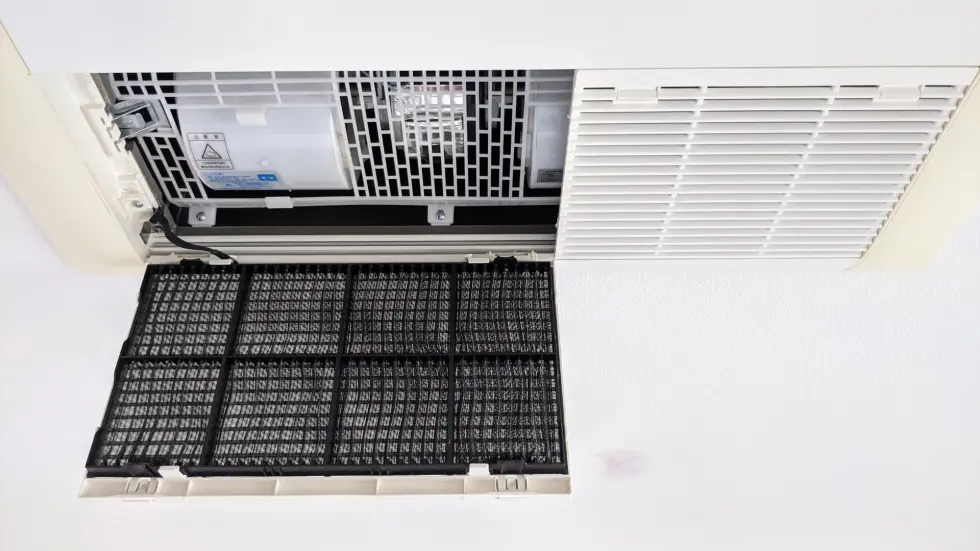
Next, removable parts such as the front panel, filters, louvers, and drain pan are disassembled according to the model.
In commercial air conditioners, dirt tends to accumulate more in the internal airflow path than on the visible exterior, so removing parts to expand the cleaning range is important.
For example, in ceiling cassette units, dirt tends to accumulate behind decorative panels and near the air outlets; in ceiling-suspended units, in the lower covers and airflow paths; and in wall-mounted units, around the louvers and drain routes.
Removed parts are cleaned individually, and detergents or brushing methods are selected according to the type of dirt.
2.1.3 Cleaning the Heat Exchanger and Blower Fan
The core of disassembly cleaning is washing the heat exchanger and blower fan.
Because the heat exchanger has densely packed aluminum fins, when dust and oil adhere to it, airflow is obstructed, and the dirt retains moisture, becoming a breeding ground for mold.
Meanwhile, the blower fan is responsible for sending out air, so if mold or dirt remains there, odor-causing substances are more likely to be spread into the room during operation.
In professional work, special detergents are used to loosen the dirt, and then a high-pressure washer is used to flush deep inside.
Because water pressure can reach areas that cannot be accessed by simply wiping the surface, it helps reduce reattachment of dirt and incomplete washing.
In particular, dirt trapped between the blades of the blower fan and deep inside the heat exchanger is difficult to remove sufficiently by hand alone, and this is where the effectiveness of high-pressure washing is especially apparent.
2.1.4 Checking the Drain Pan and Drainage Route
In commercial air conditioners, the condition of the drain pan, which receives condensation, and the drain hose is also important.
If slime-like dirt or mold accumulates there, it can lead to unpleasant odors and drainage problems.
During disassembly cleaning, dirt inside the drain pan is removed and the drainage flow is checked to ensure there are no issues.
Although this is an easily overlooked area, it is an indispensable step in improving the internal environment of the air conditioning unit.
Since the cause of odor may lie not only in the heat exchanger but also in the drainage system, it is necessary to assess the entire interior.
2.1.5 Rinsing, Reassembly, and Operation Check
After thoroughly rinsing away detergent and dirt, the removed parts are dried while the main unit is wiped down, and then everything is reassembled in the order it was taken apart.
Finally, a test run is performed to check airflow, unusual noise, water leakage, remote control operation, and cooling/heating performance, completing the work.
By carefully carrying out checks after cleaning, the unit can be restored not only to a visually clean state but also to proper operating condition as equipment.
Because commercial air conditioners are directly tied to comfort during business operations, it is important not just to wash them but to restore them to a state that does not interfere with use.
| Process | Main Tasks | Key Check Points |
|---|---|---|
| Pre-Inspection | Model confirmation, operation check, surrounding environment check | Unusual noise, water leakage, installation condition, location of electrical parts |
| Protective Covering | Protection of floors, walls, furniture, and electrical parts | Prevention of water damage, contamination, and safety assurance |
| Disassembly | Removal of panels, filters, louvers, and parts | Structure of each model, fragile parts |
| Internal Cleaning | Cleaning of heat exchanger, blower fan, and drain pan | Mold, oil dirt, dust, dirt in drainage route |
| Finishing | Rinsing, reassembly, test run | Airflow, odor, drainage, and normal operation check |
2.2 How It Differs from General Air Conditioner Cleaning
Commercial air conditioner disassembly cleaning differs from the simple or surface-centered air conditioner cleaning that people typically imagine, both in scope and purpose.
Removing dust from visible parts and cleaning the filter can provide a certain level of cleanliness, but to address internal mold, oil contamination, and the causes of odor, more in-depth cleaning is necessary.
Especially with commercial air conditioners, the way dirt accumulates varies greatly depending on the environment of use.
In restaurants, oil smoke accumulates; in clinics and beauty salons, fine dust and chemical residues; and in offices, dust and dirt from human traffic. If cleaning is approached with the same mindset as residential air conditioners, it is often insufficient.
The essence of disassembly cleaning is to remove dirt from places that cannot be seen and restore the entire airflow path itself to a clean state.
| Comparison Item | General Cleaning | Commercial Air Conditioner Disassembly Cleaning |
|---|---|---|
| Main Scope | Filters, exterior, wiping of visible areas | Heat exchanger, blower fan, drain pan, and internal airflow route |
| Dirt Addressed | Mainly light dust and surface dirt | Mold, oil contamination, and accumulated internal dirt |
| Equipment Used | Vacuum cleaner, cloth, simple cleaning tools | Special detergents, protective materials, high-pressure washers, etc. |
| Required Knowledge | Can often be handled at routine cleaning level | Requires understanding of each model’s structure, protection of electrical parts, and disassembly/reassembly skills |
| Suitable Situations | Daily maintenance | When odors, internal contamination, or discomfort in airflow are concerns |
In addition, cleaning of residential wall-mounted air conditioners and cleaning of commercial ceiling cassette or ceiling-suspended units differ greatly in difficulty.
With commercial units, there are more site-specific factors to check, such as installation height, space above the ceiling, complex panel structures, and whether a drain pump is present.
Therefore, it is not enough that someone can simply “clean air conditioners”—experience specifically with commercial units is important.
Furthermore, in commercial air conditioner disassembly cleaning, precision in reassembly and confirmation through test operation are indispensable.
If parts are not reattached properly or the water tray is misaligned, it may cause water leakage or unusual noise after cleaning.
Disassembly cleaning includes not just making the unit look clean, but restoring it properly as functioning equipment.
In other words, if general air conditioner cleaning is “surface-level cleaning,” then commercial air conditioner disassembly cleaning is closer to “equipment maintenance that goes deep into the internal structure.”
If you are troubled by mold odors or internal contamination in commercial air conditioners in Hamamatsu, it is important to understand the difference in work scope and cleaning methods, and to confirm whether the contractor is truly capable of performing disassembly cleaning.
3. Benefits of Requesting Commercial Air Conditioner Disassembly Cleaning in Hamamatsu
When operating a store, office, hospital, care facility, factory, or cram school in Hamamatsu, commercial air conditioners tend to run for long hours, making it easy for dust, oil, and moisture to accumulate inside.
Especially in spaces with frequent foot traffic or where cooking, customer service, or manufacturing takes place, simply wiping the visible parts is not enough to remove dirt from the heat exchanger, blower fan, or drain pan.
The greatest benefit of requesting professional disassembly cleaning is that it removes internal dirt unreachable by surface cleaning alone, making it easier to improve air quality, power consumption, and equipment lifespan all at once.
For businesses that find it difficult to suspend daily operations, the ability to prevent air conditioner problems in advance while maintaining a comfortable indoor environment is of great value.
Below is a summary of the main benefits of requesting commercial air conditioner disassembly cleaning in Hamamatsu.
| Benefit | Expected Effect | Practical Advantage for Businesses in Hamamatsu |
|---|---|---|
| Improved Air Quality | Reduction of mold and dust odors, cleaner airflow | Leads more easily to comfort for customers and employees |
| Energy Saving | Reduced unnecessary load through improved heat exchange efficiency | Helps control electricity costs during heavy cooling and heating seasons |
| Failure Prevention | Reduced risk of problems caused by clogging and poor drainage | Makes it easier to avoid business interruption and urgent repairs |
| Equipment Preservation | Reduced burden on internal components | Helps manage equipment with future replacement timing in mind |
3.1 Cleaner Air Through Root-Cause Elimination of Mold and Odors
A common misunderstanding when dealing with odors in commercial air conditioners is the idea that filter cleaning alone is sufficient.
In reality, the source of odors is often not just on the filter surface, but also in the heat exchanger, blower fan, deep inside the air outlet, the drain pan, and around the drain piping where dirt and moisture have accumulated.
When mold and dirt build up in these areas, unpleasant odors are more likely to spread into the air every time the unit operates.
Disassembly cleaning involves more than just removing panels and filters; it secures a wider cleaning range according to the internal structure and uses high-pressure washers and other tools to flush away contaminants.
The major difference from simple cleaning is that it can directly address the actual source of odor by removing hidden mold and sticky dirt from inside the unit.
In Hamamatsu, especially near restaurant kitchens, in offices where people stay for long hours, in waiting rooms, and in salons, the impression of the air itself can directly affect the overall evaluation of the facility.
If unpleasant smells come from the air conditioner, it may create the impression that the space is not properly maintained.
Conversely, maintaining a clean air environment contributes to creating a comfortable space for both users and employees.
In addition, in rooms where air tends to stagnate, not only cooling and heating performance but also discomfort during airflow and a sense of stuffiness can become issues.
Reducing internal contamination through disassembly cleaning is effective not only as an odor countermeasure but also in improving the overall quality of the indoor environment.
| Common Symptom | Possible Internal Cause | Improvement Direction Through Disassembly Cleaning |
|---|---|---|
| Moldy Smell | Mold contamination on the heat exchanger or blower fan | Aim to remove the contamination through internal cleaning |
| Sour Odor | Moisture, dirt, and contamination around the drainage system | Clean including the area around the drain pan |
| Dusty Airflow | Accumulated dirt behind the filter and inside the outlet | Remove adhered matter through cleaning after disassembly |
| Heavy Air During Business Hours | Decline in airflow quality due to internal contamination | Restore a clean airflow environment |
3.2 Reducing Electricity Costs Through the Energy-Saving Effect of Disassembly Cleaning
The dirtier the inside of a commercial air conditioner becomes, the more likely airflow and heat exchange efficiency will decline.
For example, if dust and oil adhere to the heat exchanger, the unit may continue running longer than necessary before reaching the set temperature.
If dirt accumulates on the blower fan, airflow volume decreases and affects perceived temperature, leading to a negative cycle where the temperature setting is adjusted more aggressively.
Disassembly cleaning is maintenance that helps restore the air conditioner closer to a state where it can perform as originally intended.
If the load caused by dirt is reduced, cooling and heating efficiency can improve, making it easier to reduce wasted power consumption.
Hamamatsu is a region where many businesses need to consider both summer cooling loads and winter heating loads.
Not only office buildings and roadside stores, but also high-ceiling workspaces and stores with many visitors tend to have long operating hours for air conditioning, so even a slight difference in efficiency can affect monthly electricity bills.
By introducing regular disassembly cleaning, it becomes easier to balance equipment preservation and utility cost control.
Of course, the amount of savings depends on the model, installation environment, operating time, degree of contamination, and set temperature.
However, in many real-world settings, properly cleaning an internally contaminated unit tends to be more advantageous in terms of efficiency than leaving it heavily soiled.
In particular, businesses in the following environments tend to experience stronger energy-saving benefits:
- Stores that operate air conditioners almost every day for long business hours
- Offices and restaurants where room temperature rises easily due to kitchen equipment, computers, or lighting
- Facilities with large fluctuations in visitor numbers and frequent door opening and closing
- Businesses operating multiple units at the same time, such as 4-way ceiling cassette units, ceiling-suspended units, or wall-mounted units
| Internal Condition | What Is Likely to Happen | Impact on Business Operations |
|---|---|---|
| Dirt on the Heat Exchanger | Cooling and heating efficiency tends to decline | Temperature settings tend to be increased or decreased more, raising power load |
| Dust on the Blower Fan | Airflow reduction and uneven distribution are more likely | Indoor comfort tends to decrease |
| Dirt Around the Drainage System | Moisture and odors are more likely to occur | The overall impression of the air conditioning tends to worsen |
3.3 Extending Equipment Lifespan and Reducing Breakdown Risk
Commercial air conditioners are expensive pieces of equipment, and sudden failures can have a major impact not only in repair costs but also on business operations.
If cooling stops, the indoor environment or work environment worsens in summer; if heating stops, it directly affects customer satisfaction and employee comfort in winter.
Especially in reservation-based stores, medical and welfare facilities, or sites handling food, air conditioning troubles can lead to major lost opportunities.
Disassembly cleaning does not completely prevent failures, but it is effective in reducing the risk of malfunctions caused by accumulated dirt.
For example, water leaks caused by clogged drain systems, increased load due to internal contamination, and poor air discharge may all be partly caused by insufficient cleaning.
Regular internal cleaning makes it easier to detect abnormalities early and address them before they develop into major failures, which is a practical advantage.
In addition, because disassembly cleaning involves removing the outer panels and checking inside, it becomes easier to notice the progression of hidden dirt and the condition of internal components.
This makes it easier not only to clean but also to plan future maintenance.
For businesses that want to use their equipment safely for as long as possible, cleaning is worth considering not just as a one-time cosmetic measure but as part of maintenance management.
In Hamamatsu, some businesses carry out cleaning before peak seasons in order to avoid the risk of air conditioners stopping during busy periods.
By preparing the unit before summer or winter, it helps prevent trouble during periods when the load becomes higher.
| Symptom Often Left Untreated | Possible Trouble | Significance of Performing Disassembly Cleaning |
|---|---|---|
| Water Leakage | Clogging due to dirt in the drain pan or drainage path | Cleaning around the drainage system makes it easier to reduce clogging risk |
| Poor Performance | Performance decline due to dirt on the heat exchanger or fan | Helps reduce internal load |
| Concern About Unusual Noise or Vibration | Imbalance caused by dirt adhesion, etc. | Combined with inspection, it helps detect abnormalities early |
| Sudden Shutdown | Partly caused by increased load from long-term dirt accumulation | Can be managed systematically as part of preventive maintenance |
Commercial air conditioners are not equipment that is simply purchased and forgotten; their performance is maintained through regular cleaning and maintenance.
Requesting disassembly cleaning in Hamamatsu is not merely about improving appearance, but can be considered a realistic form of equipment management that protects air quality, reduces wasted electricity costs, and lowers the business risk caused by breakdowns.
4. Key Points for Choosing a Contractor for Commercial Air Conditioner Disassembly Cleaning in Hamamatsu
When requesting disassembly cleaning of a commercial air conditioner in Hamamatsu, it is important not to decide based on low price alone, but to compare comprehensively, including cleaning quality, work safety, impact on store or office operations, and post-service support.
Commercial air conditioners come in many types, such as ceiling cassette, ceiling-suspended, wall-mounted, and units used around kitchens, and the way dirt accumulates and the required work vary depending on the installation environment.
That is why whether the contractor can make proposals suited to the site greatly affects the final result and satisfaction.
In Hamamatsu, in particular, air conditioner usage time and load differ by industry, including restaurants, beauty salons, clinics, offices, factories, and cram schools.
In spaces with high foot traffic, environments where oil smoke or dust is generated, or facilities that operate continuously for long hours, surface cleaning alone may not be sufficient.
If you are requesting disassembly cleaning, it is important to choose a contractor who not only supports a wide range of models but also understands the facility’s operational conditions and can plan the work accordingly.
4.1 How to Identify a Reliable Contractor: Track Record and Technical Skills
The first thing to check is the contractor’s track record in commercial air conditioner disassembly cleaning.
Even if they have experience cleaning residential air conditioners, commercial units are more complex and require specialized knowledge to handle drain pans, heat exchangers, blower fans, decorative panels, and electrical components.
Be sure to confirm whether they have extensive experience cleaning commercial air conditioners and understand disassembly procedures, protective covering, and the appropriate use of cleaning agents for each model.
Additionally, the clarity and thoroughness of explanations during the estimate are important indicators.
Reliable contractors clearly explain the condition of the dirt, the necessary scope of disassembly, estimated working time, the possibility of additional work, and the expected improvements after the job.
On the other hand, if a contractor emphasizes only low prices without detailed explanations or claims “uniform pricing for all models,” the work scope may be unclear, so caution is needed.
It is also important to check whether they are covered by liability insurance in case of unexpected issues.
Commercial air conditioners are expensive equipment, and consideration for surrounding structures such as ceilings, floors, furniture, computers, and medical devices is essential.
Even with proper preparation and procedures, unforeseen issues can occur, so insurance coverage provides peace of mind.
4.1.1 Technical Skill Checklist to Confirm Before Getting a Quote
Technical ability is not always visible, but it can be partially assessed from responses during inquiries and the contents of the estimate.
Checking the following items can help prevent misunderstandings after placing an order.
| Item to Check | What to Look For | Reason for Checking |
|---|---|---|
| Supported Models | Whether they support ceiling cassette (4-way), ceiling-suspended, wall-mounted types, etc. | Because disassembly methods and tools differ depending on the model |
| Cleaning Scope | Whether target parts such as panels, filters, heat exchangers, blower fans, and drain pans are clearly specified | Because price alone does not allow comparison of work content |
| Protection and Safety Measures | Whether protection methods for surrounding equipment, floors, walls, and ceilings are explained | To protect store or office assets and reduce risks of water damage or contamination |
| Cleaning Agents and Methods | Whether they use appropriate detergents and high-pressure cleaning depending on the type of dirt | Because oil, mold, and dust require different treatments |
| Post-Work Check | Whether they perform operation checks, test runs, and drainage confirmation | To prevent malfunctions or water leakage after cleaning |
| Insurance Coverage | Whether liability insurance is clearly stated | To prepare for unexpected equipment trouble |
4.1.2 Key Points When Checking Track Records
Even if a contractor states they have “work experience,” it may not be clear what kind of on-site experience they actually have.
Therefore, reviewing their track record from the following perspectives helps make a more concrete judgment.
Whether they have experience working in industries similar to your own is an important point.
For example, restaurants require experience dealing with oil-based dirt, clinics and salons require attention to hygiene, and offices require flexibility for work outside business hours.
Rather than just the number of cases, check whether they can adapt to site-specific conditions.
If there are case studies with photos, it is helpful to check not only before-and-after images but also which parts were cleaned, how many units were handled, how long the work took, and whether it was done during or outside business hours.
It is also effective to ask for examples of similar facilities when requesting a quote.
4.2 Advantages of Choosing a Local Hamamatsu-Based Contractor
When requesting disassembly cleaning of commercial air conditioners in Hamamatsu, local contractors have significant advantages.
They are easier to coordinate for on-site inspections and estimates and can respond more quickly to sudden issues or additional requests.
From pre-work meetings to post-work support, the physical proximity directly contributes to a sense of reliability, which is a unique benefit of local contractors.
Disassembly cleaning is not just about cleaning—it requires coordination with business schedules.
In Hamamatsu, stores and offices have different constraints, such as before or after business hours, regular holidays, or avoiding peak seasons.
Local contractors are more familiar with road conditions and travel times, making it easier to handle flexible scheduling, including multiple visits if necessary.
They are also easier to contact for follow-up visits if issues such as lingering odors or drainage problems arise after the work.
Even if remote contractors offer wide coverage, scheduling can become difficult during busy periods.
Therefore, in addition to price, it is important to consider whether you can easily consult them when something happens.
4.2.1 Cases Where Local Contractors Are Suitable
Local contractors in Hamamatsu are particularly suitable in the following situations:
| Situation | Why Local Contractors Are Suitable |
|---|---|
| Work required outside business hours | Easier to arrange detailed schedules such as early morning, night, or closed days |
| Requesting multiple stores or units sequentially | Easier to plan phased work with on-site inspections |
| Concern about post-work issues | Easier to request rechecks or additional support |
| First time requesting commercial cleaning | More likely to receive careful explanations based on actual site conditions |
| Considering regular maintenance | Easier to establish ongoing maintenance plans |
4.2.2 Points to Confirm Even with Local Contractors
Do not rely solely on the term “local”—be sure to confirm the actual service details.
For example, even if a company is based in Hamamatsu, quality may vary if they rely heavily on subcontractors.
It is reassuring to confirm whether the same person handles both estimation and work, whether outsourcing rates are low, and whether there is a clear contact point for post-work inquiries.
If regular cleaning is planned, it is also important to check how easy it is to make future reservations and whether the same staff will continue managing the site.
Contractors who understand equipment conditions and periods when dirt accumulates more easily tend to provide more stable maintenance quality.
4.3 Workflow from Estimate to Aftercare
When selecting a contractor, it is important not only to look at pricing but also to confirm whether the process from inquiry to completion is clearly defined.
Since the required steps for disassembly cleaning vary depending on site conditions, insufficient pre-checks may lead to additional charges or extended work time on the day.
Contractors with a well-organized process before the request tend to have higher transparency and fewer issues.
Generally, the process includes inquiry, site inspection or consultation, quotation, scheduling, work execution, test operation and final check, and aftercare if necessary.
Depending on the site, factors such as ceiling height, breaker location, parking space for work vehicles, business hours, and the need for ladders or scaffolding are also checked in advance.
4.3.1 Typical Request Flow
| Stage | Details | What the Client Should Confirm |
|---|---|---|
| Inquiry | Provide model, number of units, installation location, dirt condition, and preferred date | Whether responses by phone or email are polite and answer questions specifically |
| Site Inspection / Consultation | Check installation conditions, dirt level, work space, and operational constraints | Whether proposals are tailored to the site and potential additional work is explained |
| Quotation | Present work details, target areas, pricing, and estimated time | Whether breakdown details are clear, not just a lump sum |
| Scheduling | Set the work date according to business hours or holidays | Flexibility for early morning, night work, or multiple units |
| Work Day | Perform protection, disassembly, cleaning, rinsing, reassembly, and test run | Whether explanations are given before and after and proper care is taken for surroundings |
| Post-Work Check | Confirm operation, airflow, drainage, and odor | Whether contact methods and conditions for follow-up are clearly defined |
4.3.2 Questions to Ask During the Estimate
When comparing quotes, it is important to align conditions rather than focusing only on price.
Asking the following questions in advance helps prevent trouble after ordering:
“What is included in the listed price?”, “Which parts will be disassembled?”, “Are there additional charges for heavy dirt?”, “Are parking or night work fees required?”, and “What happens if issues arise after the work?”
If requesting multiple units, also check whether same-day work is possible and whether work can be divided by store or floor to match operational needs.
For restaurants and offices, minimizing the impact on business operations is crucial.
4.3.3 Points to Confirm in Aftercare
Although disassembly cleaning is completed on the same day, aftercare is an important factor in choosing a contractor.
If issues such as lingering odors, water droplets, or drainage concerns arise after the work, having a clear contact point provides reassurance.
Choosing a contractor with a proper post-work support system, not just completing the cleaning, leads to long-term satisfaction.
Additionally, contractors who provide guidance on the next cleaning schedule, filter cleaning frequency, and daily inspection points make equipment management easier.
From the perspective of failure prevention and hygiene management, it is important to compare not only one-time costs but also whether ongoing consultation is possible.
When selecting a contractor for commercial air conditioner disassembly cleaning in Hamamatsu, evaluating five key factors—track record, technical ability, local responsiveness, clarity of estimates, and aftercare—makes decision-making easier.
While price is important, confirming “how far they disassemble, how thoroughly they clean, and whether they take responsibility through post-work support” is essential to avoid mistakes in your request.
5. Cost Estimates for Commercial Air Conditioner Disassembly Cleaning in Hamamatsu
When requesting disassembly cleaning of a commercial air conditioner in Hamamatsu, the cost varies depending on the model, horsepower, installation conditions, level of contamination, and working hours.
In particular, since usage environments differ among stores, offices, clinics, factories, and restaurants, it is common for estimates to vary even for the same ceiling cassette type.
When checking cost estimates, it is important not to judge solely by the lowest price, but to compare including the scope of work and whether additional fees apply.
The depth of disassembly, the cleaning range of the heat exchanger and blower fan, whether the drain pan is removed, protective covering, wastewater collection, and whether a test run is included can significantly change the service content beyond the apparent price.
Additionally, even within Hamamatsu City, costs may vary depending on the area and travel conditions, such as Naka Ward, Higashi Ward, Nishi Ward, Minami Ward, Hamakita Ward, Kita Ward, and Tenryu Ward.
Use price ranges only as a reference, and make your final decision based on a formal estimate after an on-site inspection.
5.1 Differences in Pricing by Model and Number of Units
The cost of disassembly cleaning for commercial air conditioners varies more widely than for residential units, depending on the indoor unit type.
Common types requested in Hamamatsu include ceiling cassette, ceiling-suspended, wall-mounted, and floor-standing units.
In particular, four-way ceiling cassette units are widely used in stores and offices, and since they have more components to disassemble, they tend to be more expensive than standard wall-mounted units.
5.1.1 Estimated Costs by Main Model Types
The following are general estimates when considering commercial air conditioner disassembly cleaning in Hamamatsu.
Actual prices vary depending on each contractor’s pricing structure, scope of work, and installation conditions.
| Model Type | Estimated Cost per Unit | Factors Affecting Price |
|---|---|---|
| Ceiling Cassette (1-way / 2-way) | Approx. ¥20,000–¥35,000 | Panel structure, installation height, level of contamination |
| Ceiling Cassette (4-way) | Approx. ¥25,000–¥40,000 | Number of components, fan cleaning, drain system condition |
| Ceiling-Suspended Type | Approx. ¥25,000–¥45,000 | Installation height, workspace, presence of oil contamination |
| Commercial Wall-Mounted Type | Approx. ¥15,000–¥30,000 | Ease of disassembly, condition of heat exchanger |
| Floor-Standing Type | Approx. ¥25,000–¥45,000 | Unit size, condition of drain pan and drainage system |
These are only reference ranges, and in environments such as restaurants where oil-based contamination is common, costs may be higher than standard pricing.
On the other hand, in offices or meeting rooms with relatively light contamination, the cost may fall within the standard range.
5.1.2 Differences Based on Horsepower and Capacity
Even for the same type, as capacity increases (e.g., 2.5 HP, 4 HP, 5 HP or more), the internal structure and components become larger, increasing the labor required for cleaning.
For this reason, some contractors set prices based on capacity rather than type.
When reviewing estimates, it is helpful to check whether the model number and horsepower are reflected, not just the unit type.
5.1.3 Considerations When Requesting Multiple Units
In Hamamatsu, there is strong demand from stores and businesses to clean multiple units at once before peak seasons.
In such cases, the unit price per unit may decrease.
For example, when requesting cleaning for 2, 3, or more units of the same model within the same facility, efficiency in preparation and equipment setup improves, and package pricing or volume discounts may apply.
| Request Method | Cost Trend | Suitable Cases |
|---|---|---|
| Single Unit | Standard pricing applies | When only one unit has odor or mold issues |
| 2–3 Units in Same Facility | Possible volume discount | Small offices, clinics, small stores |
| 4 or More Units at Once | Lower cost per unit | Offices, factories, restaurant chains, multi-floor facilities |
However, if night work, after-hours work, parking conditions, or the need for ladders or high-elevation work are involved, costs may not decrease as much as expected.
It is important to compare not only volume discounts but also whether the work scope per unit is consistent across estimates.
5.2 Cases Where Additional Fees May Apply
One important point to watch during estimation is additional charges.
For commercial air conditioner disassembly cleaning, what is included in the base price and what is considered optional varies by contractor.
To avoid pricing issues, it is necessary to clearly confirm in advance what is included in the standard service and what is optional.
5.2.1 Common Items That May Incur Additional Fees
| Additional Item | Reason It Occurs | Points to Confirm |
|---|---|---|
| High Installation Location | Requires ladders, scaffolding, or additional staff | Ceiling height, open ceilings, presence of signage |
| Heavy Oil or Tar Contamination | Requires more detergent and longer cleaning time | Restaurant use, smoking environment, proximity to kitchen |
| Additional Disassembly (Drain Pan / Fan) | More steps than standard disassembly | Confirm in advance how far disassembly goes |
| Anti-Mold / Antibacterial Coating | Often treated as an optional service | Duration of effect, necessity, cost |
| Outdoor Unit Cleaning | Handled separately from indoor unit | Whether bundled pricing is available, installation safety |
| Night / Early Morning / Holiday Work | Extra charge for off-hours work | Time thresholds and attendance requirements |
| Travel / Parking Fees | Actual costs vary by location and parking conditions | Whether flat rate applies within Hamamatsu or extra fees apply for distance |
5.2.2 Why Costs Tend to Increase in Restaurants and Factories
In Hamamatsu, there are many environments such as restaurants, food-related facilities, and manufacturing sites where oil and dust are prevalent in the air.
In such environments, heavy contamination tends to accumulate on heat exchangers and blower fans, making standard high-pressure cleaning more time-consuming.
As a result, additional cleaning agents, more disassembly steps, and additional staff may be required, increasing costs.
Facilities with strict hygiene requirements may also request antibacterial treatment after cleaning or regular maintenance contracts.
While these improve comfort and hygiene, they typically incur additional costs beyond one-time cleaning.
5.2.3 Items to Confirm in Estimates
To avoid unexpected costs, it is recommended to confirm the following points in advance:
- Whether the cleaning includes only the indoor unit or also the outdoor unit
- How far cleaning covers: heat exchanger, blower fan, drain pan, filters
- Whether protective covering, test run, wastewater processing, and basic inspection are included
- Whether high-elevation fees, parking fees, or night work charges apply
- Scope of response if repairs or part replacements are required
Since “full disassembly cleaning” alone does not clearly indicate the scope, estimates with itemized breakdowns are easier to compare and make it easier to request services with confidence.
5.2.4 Comparison Points Beyond Price
Low prices are attractive, but commercial air conditioners require model-specific expertise and on-site adaptability.
Major manufacturers widely used in Japan—such as Daikin, Mitsubishi Electric, Hitachi, Panasonic, and Toshiba Carrier—have different structures and disassembly procedures depending on the model.
When comparing prices, it is helpful to also check experience with supported models, liability insurance coverage, and whether work reports with photos are provided.
If you want to check product information or manuals, you can refer to publicly available resources such as Daikin Industries, Mitsubishi Electric Air Conditioning & Ventilation, and Japan Refrigeration and Air Conditioning Industry Association.
Ultimately, rather than focusing only on low unit prices, comparing work content, conditions for additional fees, and post-service explanations will lead to a satisfactory commercial air conditioner disassembly cleaning experience in Hamamatsu.
6. Frequently Asked Questions: Commercial Air Conditioner Disassembly Cleaning in Hamamatsu
We have compiled frequently asked questions from those considering commercial air conditioner disassembly cleaning in Hamamatsu for stores, offices, clinics, factories, and other facilities.
We have organized and explained key points such as work time, recommended frequency, impact on business operations, supported models, and precautions in case of malfunction so they are easy to understand, especially for first-time requests.
6.1 About Work Time and Frequency
6.1.1 How long does commercial air conditioner disassembly cleaning take?
Work time varies depending on the type of air conditioner, installation conditions, level of contamination, and number of units.
In general, for one commercial air conditioner such as a 4-way ceiling cassette type or a ceiling-suspended type, it is common to allow several hours including protective covering, disassembly, cleaning, rinsing, reassembly, and test operation.
Whether work can be carried out during business hours depends on factors such as work noise, water usage, and whether ladders are required, so prior confirmation is important.
For restaurants, beauty salons, hospitals and clinics, cram schools, and similar facilities, carrying out the work before opening, after closing, on regular holidays, or during consecutive holidays can help reduce the impact on operations.
| Check Item | Details |
|---|---|
| Estimated Work Time | Varies depending on the model, level of contamination, installation conditions, and number of units |
| Cases Where Work Tends to Take Longer | Heavy oil contamination, extensive mold buildup, high installation positions, many parts, simultaneous work on multiple units |
| Impact on Business Operations | Because there is work noise and people coming in and out, it is often more suitable to carry out the work before/after business hours or on closed days |
| Information to Communicate in Advance | Business hours, customer traffic flow, parking availability, breaker location, ceiling height, photos of the installation site |
6.1.2 How often should disassembly cleaning be performed?
The frequency depends greatly on the usage environment.
In stores and offices where heating and cooling operate for long hours, restaurants where oil smoke is generated, factories and workshops with a lot of dust, and facilities with frequent visitor traffic, dirt tends to accumulate more quickly.
As a general guideline, environments where the system is used for long hours on a daily basis require consideration of regular inspections and cleaning.
In particular, if you notice symptoms such as odor coming from the air outlet, poor performance, visible mold, concerns about water leakage from the drain pan, or no improvement even after filter cleaning, it is safer to consult a professional without waiting for a specific season.
6.1.3 Is it better to request the service before peak seasons?
Yes. Requests tend to increase before summer and winter, which can make it harder to secure your preferred schedule.
In Hamamatsu as well, when temperatures and humidity rise, air conditioner use increases, and more people notice odors or poor performance and request service.
Planned disassembly cleaning before the peak cooling or heating season helps prevent trouble and maintain comfort.
For facilities with multiple units, it is also efficient to carry out the cleaning all at once during off-peak periods.
6.1.4 Is it necessary to be present on the day of the work?
In general, it is smoother if someone can be present at the start and end of the work.
Before the work, operation and installation conditions are usually checked, and after the work, a test run and finish check are performed.
Methods for key handover and procedures when the responsible person is absent vary by contractor, so confirm these during prior discussions.
In some cases, sharing information with the property management company or tenant administrator may also be necessary.
6.2 What Types of Commercial Air Conditioners Are Supported?
6.2.1 What types of commercial air conditioners are supported?
Commercial air conditioners come in multiple configurations, and whether disassembly cleaning is possible and how it is performed varies by model.
The main types commonly seen in stores and offices in Hamamatsu are as follows.
| Type | Typical Installation Location | Features |
|---|---|---|
| 4-Way Ceiling Cassette Type | Offices, stores, clinics | A representative commercial type often used in large spaces |
| 2-Way / 1-Way Ceiling Cassette Type | Small stores, backyards | Adopted according to available installation space |
| Ceiling-Suspended Type | Factories, meeting rooms, stores | A type suspended from the ceiling; checking the airflow direction is important |
| Wall-Mounted Type | Offices, break rooms, small stores | Looks similar to residential models, but some are used for commercial purposes |
| Floor-Standing Type | Facilities, offices, some stores | Installed near floor level, so surrounding protection must be checked |
Whether support is possible depends on the manufacturer, model number, year, installation height, the presence of a ceiling inspection hatch, and the routing of pipes and wiring, so sharing model information at the estimate stage is important.
6.2.2 Can you handle models from Daikin, Mitsubishi Electric, Hitachi, Panasonic, etc.?
Commercial air conditioners from major manufacturers widely used in Japan—such as Daikin, Mitsubishi Electric, Hitachi, Panasonic, Toshiba Carrier, and Mitsubishi Heavy Industries—are commonly found on-site.
However, support is not determined by the manufacturer name alone; it is necessary to check the model number, year, parts supply status, and whether there are any special specifications.
For older models or special installation conditions, there may be limitations on the scope of disassembly.
Sending a photo of the indoor unit nameplate before requesting service helps speed up confirmation.
6.2.3 Can old commercial air conditioners still be disassembly-cleaned?
Some older models can still be worked on, but caution is needed if aging has progressed.
Depending on factors such as cracked plastic parts, deteriorated wiring, the condition of motors and control boards, and whether parts supply has ended, repair or replacement may need to be considered before cleaning.
In particular, if there are problems such as abnormal noise, frequent error displays, water leakage, insufficient cooling, or insufficient heating, it cannot be assumed that cleaning alone will solve the issue.
It is important to distinguish between fault diagnosis and disassembly cleaning.
6.2.4 Can I request service for models with automatic cleaning functions or other special features?
Some commercial air conditioners are equipped with sensors, automatic control functions, or ventilation-linked functions.
These models have more areas that must be protected and more complex disassembly procedures, so it is better to consult a contractor with relevant experience.
In addition, sites with high ceilings, areas around kitchens, medical or care facilities, and spaces with precision equipment require more careful protective covering and process management than usual.
This makes prior on-site confirmation important.
6.2.5 Should I request outdoor unit cleaning at the same time?
Disassembly cleaning is often centered on the indoor unit, but depending on the installation environment, checking the outdoor unit’s condition is also important.
Outdoor units can be affected by soil dust, fallen leaves, exhaust gas, sea breeze, and similar factors.
However, whether outdoor unit cleaning is necessary depends on its condition.
Since its purpose differs from mold and odor control in the indoor unit, it is appropriate to assess the actual condition and determine the necessary work rather than treating indoor and outdoor units the same way.
6.2.6 Can I request service for multiple units at once?
Yes.
In office buildings, stores, clinics, care facilities, and factories, it is common to request service for multiple units at the same time.
If there are many units, it may be necessary to divide the work by day, proceed floor by floor, or start in areas with the least impact on operations.
For simultaneous requests, estimates go more smoothly if you organize the model list, installation locations, usage conditions, and priority order in advance.
It also has the advantage of making it easier to schedule the work before peak seasons.
6.2.7 What information should I prepare for the estimate?
To improve the accuracy of the estimate, the following information is useful.
| Information to Prepare | Purpose of Confirmation |
|---|---|
| Model Name / Model Number / Manufacturer | To confirm whether service is possible, required materials, and work process |
| Photos of the Installation Site | To check ceiling height, ladder accessibility, and surrounding protection requirements |
| Number of Units | To check number of workers, required time, and scheduling |
| Symptoms | To understand in advance issues such as odor, mold, poor performance, or water leakage |
| Preferred Dates and Times | To confirm whether before/after business hours, closed days, or nighttime work is needed |
Having photos and the model number alone greatly helps in determining the estimate and whether the work is possible.
Especially for stores and business facilities in Hamamatsu, sharing information about parking space and carrying routes also helps the work proceed more smoothly on the day.
6.2.8 Will disassembly cleaning definitely eliminate odors and mold?
Disassembly cleaning is effective for removing dirt attached to the heat exchanger, blower fan, drain pan, and around the air outlet.
However, if the cause of the odor lies outside the air conditioner itself, or if it is related to inadequate building ventilation, drainage pipe problems, or odors deeply embedded over many years, it cannot always be guaranteed that cleaning alone will completely eliminate it.
For that reason, during the preliminary check, it is important to communicate details such as “when the odor started,” “whether it occurs only during cooling,” or “whether it becomes stronger on rainy days.”
This makes it easier to identify the cause.
6.2.9 Can a malfunctioning commercial air conditioner still be cleaned?
If there is an error display, the unit does not run, there is abnormal noise, or water leakage is severe, inspection is required first.
Cleaning is one type of maintenance, but it is not the same as repairing a malfunction.
Depending on the condition, repair may be needed before cleaning.
If you request cleaning without disclosing the malfunction, responsibility after the cleaning can become unclear, so it is important to communicate symptoms accurately in advance.
6.2.10 Can I consult about payment methods and billing arrangements?
For corporate clients and stores, options such as invoice payment or bank transfer may be preferred in addition to cash payment.
Available methods differ by contractor, so confirm them at the estimate stage.
Whether a work report is provided, whether photos can be submitted, and whether invoice-system compliance is available are also important points for business operators.
Especially for multiple locations or multi-store operations, procedures go more smoothly if you organize the invoice name, work site name, and responsible person’s name in advance.
The optimal way to proceed with commercial air conditioner disassembly cleaning varies depending on the model, installation environment, and usage conditions.
If you are unsure, preparing these three things—“model number,” “installation photos,” and “current symptoms”—is the best first step to avoid mistakes.
7. Summary
Carrying out commercial air conditioner disassembly cleaning in Hamamatsu is an important measure not only for removing mold and odors, but also for reducing electricity costs and extending equipment lifespan.
Especially in stores and offices, the comfort of the air environment affects the impression of employees and customers.
That is why it is important not to decide based on price alone, but to confirm track record, scope of work, supported models, and aftercare, and then request the service from a reliable contractor.
Maintain a safe and comfortable air conditioning environment through regular disassembly cleaning.